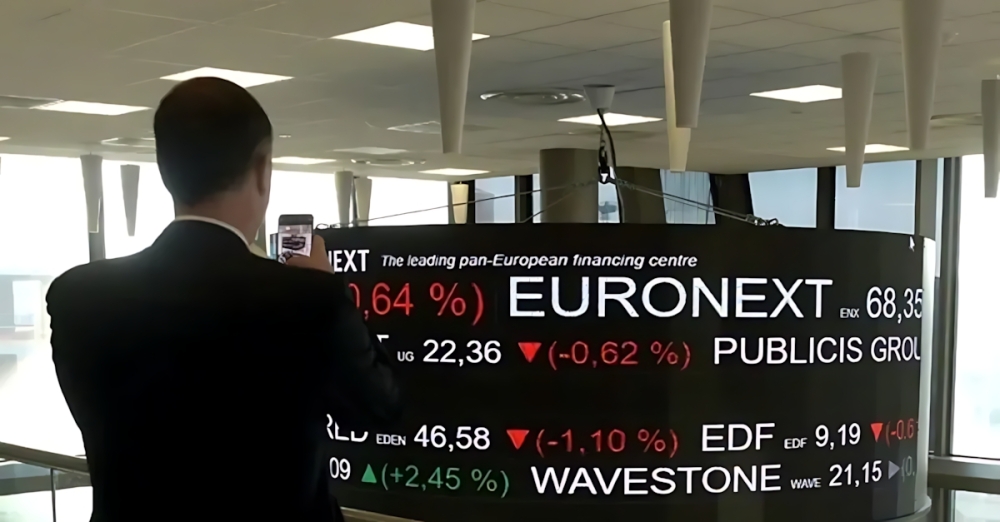
Global financial markets have recently witnessed significant shifts, with European stocks a sharp decline to their lowest level in four months. This notable drop was primarily driven by a severe sell-off in defense sector stocks, sparking investor anxiety and prompting a reassessment of their portfolios. Specifically, the pan-European STOXX 600 index fell by 1.6%, settling at 564.13 points. This decline marks the continuation of a downward trend, with the index recording its third consecutive weekly loss at the close of trading last Friday. The decline was not limited to any one sector; all sectors traded in negative territory, with industrial stocks being the biggest drag on the overall index.
The economic context and the impact of geopolitical tensions on European stocks
To understand the reasons for this decline, it's necessary to consider the broader context and recent historical background of the European economy. Over the past two years, defense stocks have benefited significantly from increased military spending in response to geopolitical tensions, particularly since the outbreak of the Russian-Ukrainian war. However, financial markets are volatile and often experience profit-taking or price corrections when valuations reach high levels. Furthermore, European stocks in general are under continued pressure due to the European Central Bank's tight monetary policies aimed at controlling inflation. These policies, which include keeping interest rates high, increase borrowing costs for companies, negatively impacting their profitability, especially in cyclical sectors like manufacturing, which has put considerable pressure on the Stoxx 600 index.
Expected repercussions of the decline in European stocks on global markets
The decline in European stocks is not merely an isolated local event; it has significant implications and is expected to have repercussions extending to regional and international markets. Regionally, this widespread drop across all sectors reflects uncertainty and a decline in confidence in the economic growth trajectory within the Eurozone. This downturn could lead to a slowdown in capital investment by European companies, negatively impacting employment rates and domestic economic growth.
On the international stage, the European economy represents a massive trading bloc, and any slowdown there casts a shadow over its trading partners in Asia and the United States. A decline in industrial stocks, for example, can be an early indicator of weakening global demand for manufactured goods and raw materials. Moreover, a downturn in European markets often contributes to increased risk aversion among global investors, potentially driving them toward safe havens such as gold or government bonds, and consequently impacting capital flows in emerging markets.
A future outlook for the performance of financial markets
Given these circumstances, analysts and economists are cautiously awaiting developments in the coming days. The market recovery will depend heavily on future economic data, such as inflation reports and purchasing managers' indices, as well as any new signals from the European Central Bank regarding the path of interest rates. Until then, a wait-and-see approach will likely prevail, as investors continue to assess the risks surrounding the global and domestic economies.