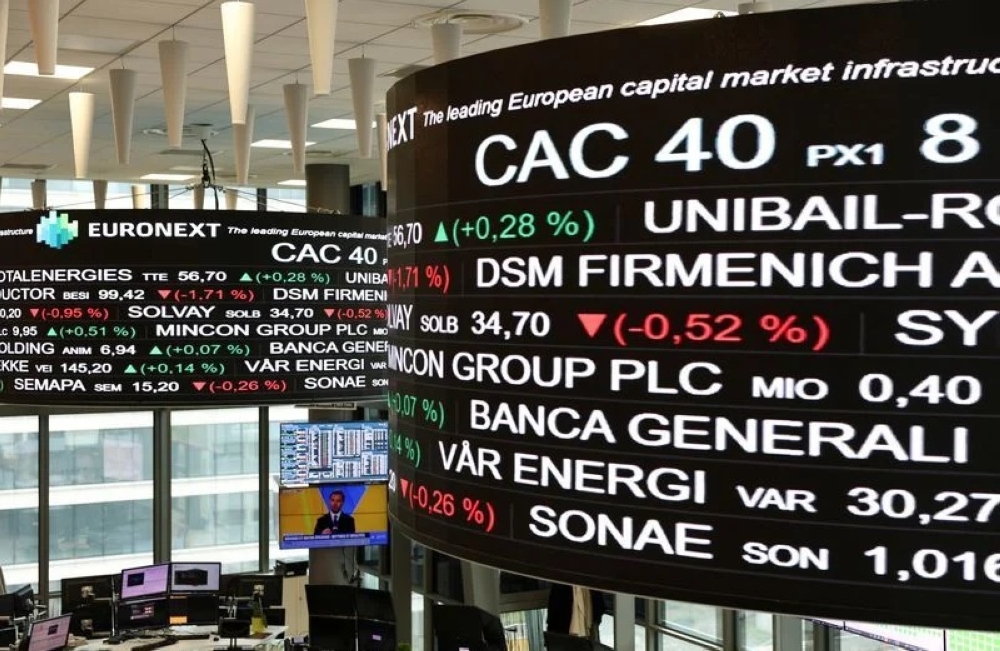
European stock markets closed mixed today, with investors remaining cautious, resulting in varying performances across the continent's main indices. This comes as global markets await new economic indicators that could shape the direction of monetary policy in the coming period.
Details of European index closings
The pan-European STOXX 600 index, the broadest benchmark for the region's stock market, ended the trading session slightly lower. The index fell 0.09% to close at 608.34 points. This slight decline reflects a sense of uncertainty among traders, as gains in some sectors offset losses in others.
In contrast, the German economy, the main engine of the European economy, showed a degree of resilience. The German DAX index settled at 24,859.36 points, virtually unchanged from previous sessions, indicating relatively stable investor confidence in major German industrial companies despite the surrounding economic challenges.
In France, the CAC 40 index joined the list of decliners, recording losses of 0.07%, ending trading at 8,143.05 points, affected by slight selling pressure on some leading stocks.
Signs of divergence in European markets
The divergence in performance among the major European indices (STOXX 600, DAX, and CAC 40) is an economic phenomenon reflecting uncertainty in the global economic landscape. This divergence typically indicates that investors are reassessing their portfolios based on the performance of individual sectors and countries, rather than making sweeping buy or sell decisions.
The Stoxx 600 index is of particular importance as it includes 600 large, medium and small companies in 17 European countries, and therefore its decline - even by a small percentage - is read as an indicator of the general mood of investment in Europe, which currently tends towards caution and anticipation.
The economic context and its impact
European stocks are directly affected by the European Central Bank's monetary policies, inflation rates, and energy prices. The stability of the German DAX index at high levels (above 24,000 points) indicates the strength of German companies' fundamentals and their ability to adapt to changes, which sends a relatively reassuring message to neighboring markets.
Internationally, European stock movements often overshadow US market openings and influence global capital flows. Analysts emphasize that this divergence in closing prices should prompt investors to focus on selecting financially sound stocks rather than relying on a general market rally.