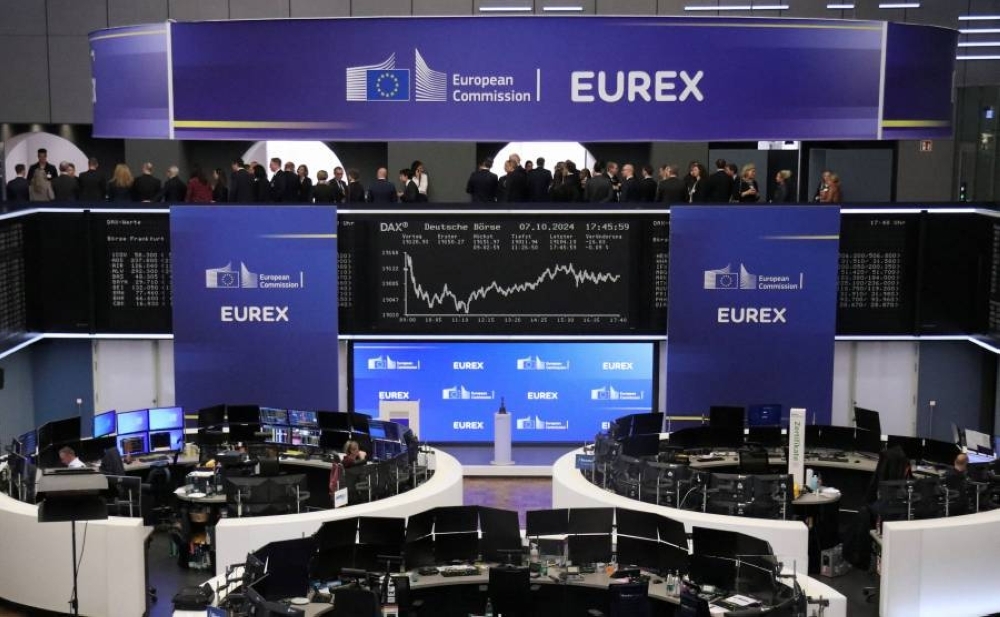
European stocks saw mixed performance today , with major indices reacting to current economic data in a complex manner. While some markets managed to post solid gains, others faced slight downward pressure. This divergence reflects the cautious sentiment among investors amid escalating global economic challenges.
European stock performance: key index closing details
In terms of daily performance, European stocks mixed movements, with the pan-European Stoxx 600 index closing 0.46% higher at 579.44 points. This rise reflects resilience across broad sectors of the European market. Conversely, Germany's DAX index, representing the Eurozone's largest economy, experienced a slight decline of 0.08%, closing at 22,576.77 points.
In France, the CAC 40 index gained 0.23%, closing at 7743.92 points. Meanwhile, London's FTSE 100 index showed mixed performance; while it rose 0.60%, it also experienced a decline of 59.35 points, settling at 9953.50 points, highlighting the internal divergence within the British market.
The economic and historical context of financial market movements
Historically, financial markets in Europe have been directly influenced by the policies of the European Central Bank and the Bank of England, particularly regarding interest rates and inflation. The Stoxx 600 index, which includes large, medium, and small companies from 17 European countries, is considered a comprehensive measure of economic health. The current rise in this index comes as markets attempt to recover from successive crises and cope with ongoing geopolitical tensions on the global stage. The contrasting performance of a declining German index and a rising French index reflects the differences in each country's economic structure and the extent to which its industrial and service sectors are affected by energy prices and global supply chains.
Expected impact on the regional and international economic landscape
This divergence in market closings carries significant implications on several levels. Regionally, the rise of the Stoxx 600 index indicates continued investor confidence in the ability of major companies to generate profits despite challenges, which supports the stability of the euro and encourages further investment. Internationally, the performance of European markets plays a pivotal role in guiding global markets. Stability or volatility in Europe often influences the openings of US (Wall Street) and Asian markets. Furthermore, the current divergence sends a message to global central banks to exercise caution when making new monetary policy decisions.
A look ahead to the trajectory of European stocks
In conclusion, financial analysts expect European stocks to continue experiencing moderate volatility in the near term. Investors will remain closely monitoring quarterly corporate earnings reports, as well as macroeconomic data related to GDP growth and inflation rates. The ability to adapt to rapid economic changes will be the decisive factor in determining the overall direction of financial markets in the coming period.