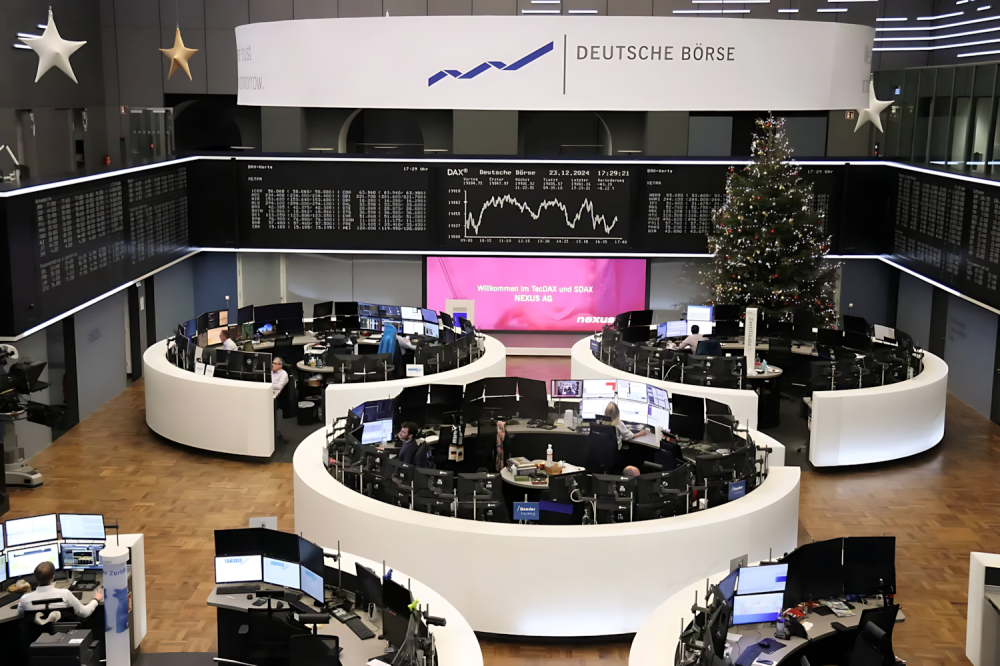
Global financial markets experienced a day of declines, with European stocks significantly lower on Thursday, prompting investor concerns and a reassessment of their portfolios. This downturn comes amidst widespread uncertainty in the global economic landscape, influenced by a range of geopolitical and macroeconomic factors that are impacting investor confidence and capital flows in major markets.
Details of the decline in European stocks and market indices
According to the closing data for the trading session, European stocks recorded significant losses across the major indices. The pan-European STOXX 600 index fell by 2.39%, settling at 583.64 points. The decline wasn't limited to the overall index; it extended to major economies in the continent. Germany's DAX index, reflecting the performance of the Eurozone's largest economy, plummeted by 2.76% to 22,852.48 points. In France, the CAC 40 index suffered notable losses of 2.03%, closing at 7,807.87 points, reflecting a widespread sell-off across various key sectors.
Economic context and history of market volatility
To understand the reasons for this decline, it's necessary to consider the broader context and historical background of market movements. Historically, European financial markets have been heavily influenced by the European Central Bank's decisions regarding interest rates and inflation. In recent periods, markets have experienced sharp fluctuations due to tight monetary policies aimed at curbing inflation, as well as energy crises and disruptions to global supply chains. These factors combine to create a cautious investment environment, with investors awaiting any new economic data that might offer clues about the region's economic growth trajectory. The current declines are reminiscent of previous periods of price corrections that followed waves of excessive market optimism.
Expected impact on the regional and international economy
The decline in market indices carries significant implications and is expected to have repercussions on several levels. Regionally and within Europe, falling stock prices lead to a decrease in the market capitalization of major companies, which could negatively impact their expansion plans and their ability to attract new investments. Furthermore, declining consumer and investor confidence could affect spending, consumption, and overall economic growth.
On the international level, the European economy is closely intertwined with global markets. A decline in European stocks often sends shockwaves through the openings of markets in the United States and Asia. In such circumstances, international investors may liquidate their high-risk assets and move towards safe havens such as gold or US Treasury bonds, impacting global liquidity and exchange rates, particularly those of the euro and the dollar.
A look ahead at European stock performance
In conclusion, the performance of European stocks remains contingent on upcoming economic developments. Analysts are closely monitoring quarterly corporate earnings reports, inflation data, and purchasing managers' indices (PMIs) to determine whether this decline represents a temporary correction or the beginning of a longer-term downward trend. The current situation requires investors to adopt flexible strategies to navigate the ongoing volatility in global financial markets.