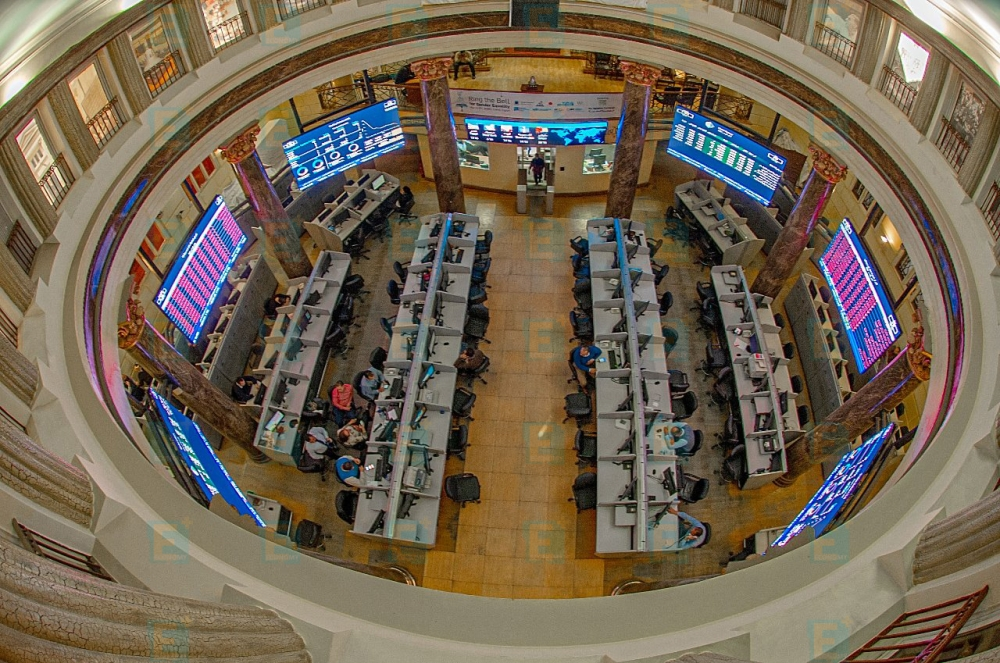
The Egyptian stock market closed sharply lower on Sunday, with all indices declining across the board. The session was marked by selling pressure that led to a drop in the market capitalization of listed companies. Market capitalization fell by approximately 39 billion Egyptian pounds by the end of trading, settling at 2.959 trillion pounds. This reflects a market correction following periods of fluctuating performance.
Key indicators performance details
The session witnessed varying rates of decline among the different indices, with the results being as follows:
- The EGX 30 index: The main index of the Egyptian Exchange (EGX) fell by 2.23%, closing at 40,898.15 points. This index is considered the most important benchmark for measuring the performance of the 30 largest listed companies in terms of liquidity and activity, and its decline usually indicates movements in leading stocks.
- The EGX70 index: The index for small and medium-sized stocks declined slightly by 0.2%, recording 13099.58 points, showing relative resilience in this sector compared to leading stocks.
- The EGX100 index: The broader index fell by about 0.4% to reach a level of 17343.7 points.
Trading volume and liquidity
In terms of liquidity, the market recorded total transactions valued at approximately EGP 23.4 billion. It is worth noting that transactions in the stock market specifically amounted to approximately EGP 4.4 billion, indicating that a significant portion of the total trading volume may have been related to bonds or off-exchange transactions, a common practice in the Egyptian Stock Exchange's trading structure to enhance overall liquidity.
Economic context and the importance of the Egyptian Stock Exchange
The Egyptian Stock Exchange is one of the oldest and most established financial markets in the Middle East and North Africa region, playing a pivotal role in the national economy as a mirror reflecting the overall economic situation and investor expectations. Daily declines, or what is known as "profit-taking," are a natural part of the financial market cycle, where investors sell shares to realize capital gains after periods of upward movement, or to restructure their investment portfolios based on changing market conditions.
Expected impact and significance of the figures
Despite today's market losses, the fact that market capitalization remains near the EGP 3 trillion mark (at EGP 2.959 trillion) reflects the inherent strength of the Egyptian market and its ability to absorb temporary shocks. These indicators are of particular importance to both local and foreign investors, as they serve as guiding tools for evaluating investment opportunities. Analysts typically monitor the support and resistance levels of the main index, EGX 30, to determine the market's future direction, whether it indicates a continuation of the correction or a return to an upward rebound.