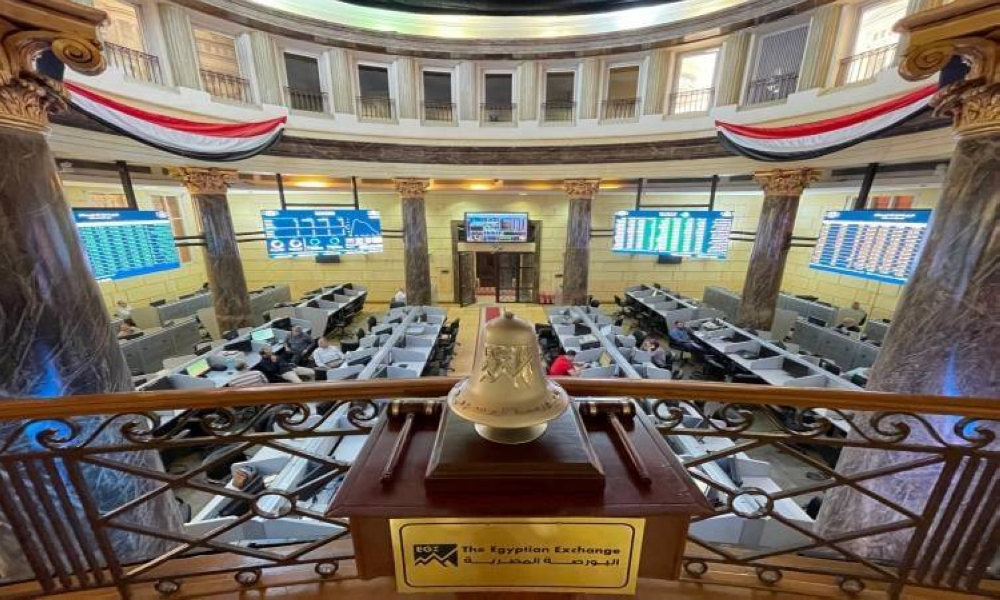
The Egyptian Stock Exchange witnessed a notable divergence in its performance at the close of trading today, as the main and sub-indices were dominated by red, closing with a slight decline, while the market capitalization recorded gains, amidst a huge and unprecedented total trading volume that reflects exceptional activity in the Egyptian financial market.
Index closing details and trading volumes
The Egyptian stock market closed in the red today, with the benchmark EGX30 index falling 0.1% to settle at 41,689.96 points. The sub-indices were not immune to this decline, with the EGX70 index for small and medium-sized enterprises dropping 0.13% to 13,144.01 points, and the broader EGX100 index declining 0.11% to close at 17,394.29 points.
Despite the decline in the indicators, the market capitalization of listed companies’ shares managed to achieve gains of about 2 billion pounds, bringing the total to a level of 2.977 trillion pounds, strongly approaching the 3 trillion pound mark, a historical level that reflects the revaluation of Egyptian assets.
Massive liquidity analysis: What lies beyond the £279 billion?
The most notable aspect of today's trading was the total trading volume, which reached a record high of approximately EGP 279.2 billion. It's important to clarify that this enormous figure doesn't solely reflect stock trading, as on-exchange transactions amounted to only about EGP 5.2 billion. The significant difference in figures is typically attributed to the activity in the bond and treasury bill market (primary dealers), in addition to large share transfer deals, indicating the market's depth and its capacity to accommodate diverse financial instruments beyond traditional stock trading.
The economic context and the importance of the stock exchange as a hedging tool
This performance comes at a time when the Egyptian Stock Exchange is witnessing increasing interest from both local and foreign investors, as stocks are currently considered a safe haven and an effective hedge against inflation. The record levels reached by the main index, exceeding 41,000 points, confirm investor confidence in the ability of listed Egyptian companies to achieve profit growth and revalue their assets in line with economic changes and the exchange rate.
The resilience of market capitalization and its achievement of gains despite the decline in indices reflects a state of selectivity in buying, as investors focus on leading stocks with strong financial solvency, which enhances the role of the stock exchange as a true mirror of the Egyptian economy and a major platform for financing companies and attracting indirect foreign investments.