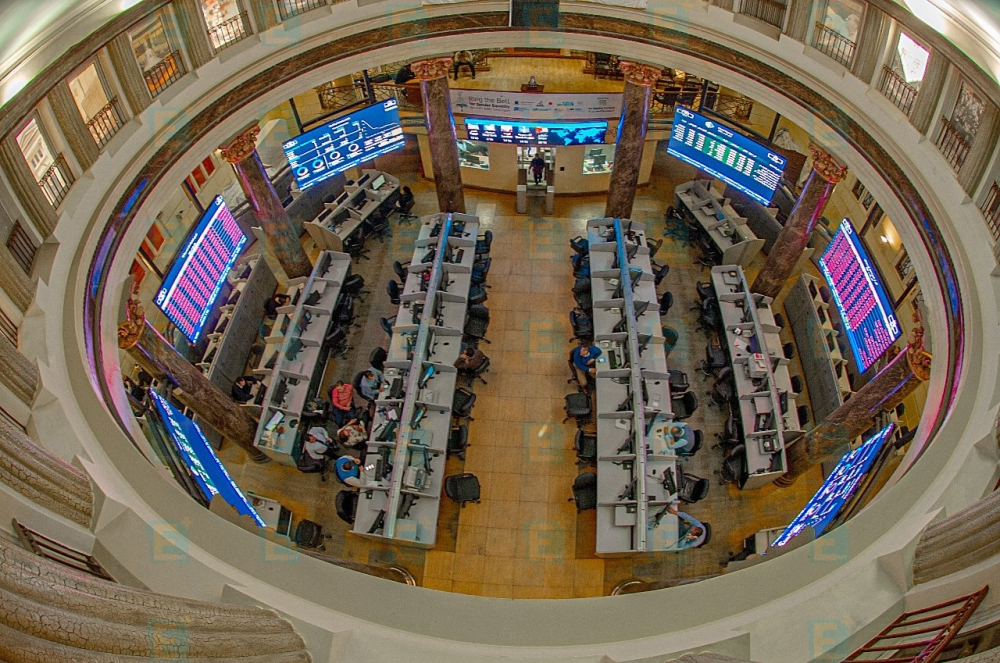
The Egyptian Stock Exchange closed today with a collective rise in its indices, supported by buying activity from local and Arab investors, thus continuing its positive trajectory that reflects a cautious optimism among traders. At the close of the session, the market capitalization of listed companies gained approximately 6 billion Egyptian pounds, closing at 3.298 trillion pounds, compared to 3.292 trillion pounds in the previous session.
Key indicators performance
The main indices showed mixed performance with a slight upward bias. The benchmark EGX 30 index rose slightly by 0.16%, reaching 50,376.15 points. The EGX 70 index for small and medium-sized enterprises also increased by 0.41%, reaching 12,935.37 points. The broader EGX 100 index climbed by approximately 0.31%, closing at 17,928.03 points. Total trading volume reached approximately EGP 208.8 billion, while the value of stock trading alone amounted to around EGP 7.8 billion.
General context and historical background
The Egyptian Stock Exchange, whose roots trace back to 1883 in Alexandria and 1903 in Cairo, is one of the oldest stock exchanges in the Middle East and Africa. While it has undergone various stages of development and faced numerous challenges, it remains a reflection of the national economy and a key indicator of investor confidence. The market's current performance reflects its response to a series of structural economic reforms adopted by the Egyptian government in recent years, aimed at improving the investment climate and attracting foreign capital.
The importance of the event and its expected impact
This surge is particularly significant given the complex global and regional economic conditions. Domestically, the market's positive performance reflects investors' response to recent economic measures, most notably the complete liberalization of the exchange rate and the increase in interest rates—steps aimed at curbing inflation and stabilizing the foreign exchange market. Furthermore, the announcement of major investment deals, such as the Ras El Hekma development project, has contributed to a more positive outlook for the Egyptian economy.
At both the regional and international levels, the stability of the Egyptian Stock Exchange reinforces its position as an attractive emerging market for investment. International investors closely monitor the performance of Egyptian markets as a gateway to investment in the region. Consequently, the continuation of this positive momentum could lead to increased foreign direct and indirect investment inflows, contributing to bolstering foreign exchange reserves, financing development projects, and strengthening the Egyptian economy's resilience to external shocks.