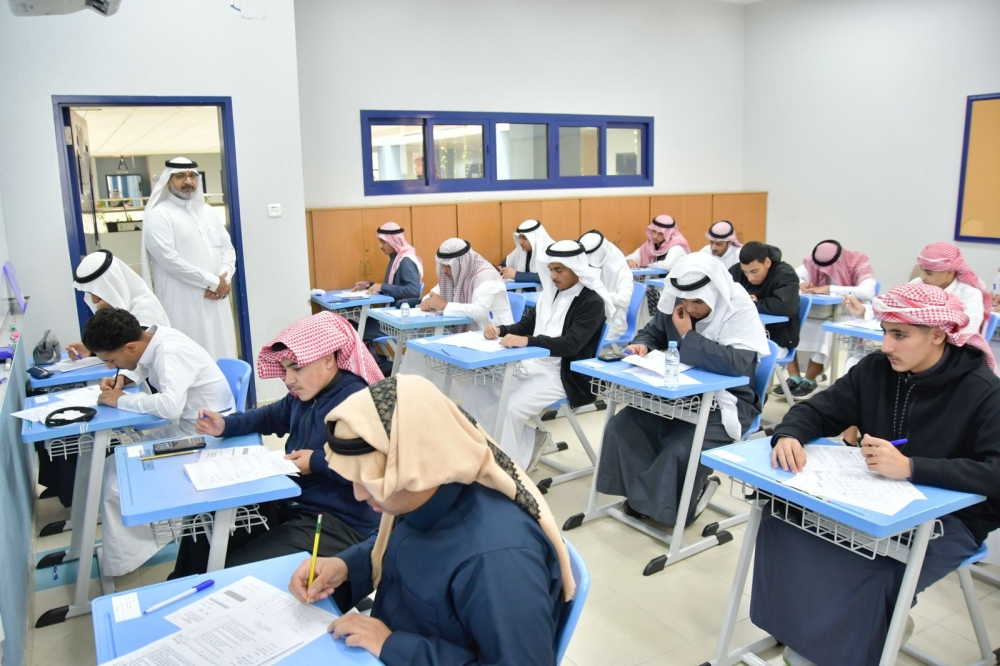
The Saudi Ministry of Education has approved a new administrative and organizational structure for managing final exams in schools, a strategic step aimed at governing educational processes and ensuring the highest standards of integrity and operational efficiency. This decision aims to precisely regulate the distribution of tasks, preventing conflicts of interest and eliminating any duplication of roles within educational institutions.
Context of institutional development and transparency
These new measures are part of a broader effort to develop the Kingdom's education system, aligning with the goals of Vision 2030, which focuses on enhancing transparency and fairness across all government sectors. Final exams are the primary benchmark for measuring learning outcomes, making their governance essential to ensuring the accuracy of educational indicators. This shift from individual efforts to organized, institutionalized practices aims to bolster public and parental confidence in the education system's outputs and guarantee every student's right to fair assessment, free from any external influences.
Hierarchical structure and academic achievement committee
The Ministry's new procedural guide adopts a hierarchical administrative model beginning with the "Academic Achievement Committee," which serves as the highest supervisory body within the school. This committee is headed by the school principal, who is ultimately responsible for ensuring that the examination process adheres to the approved regulations and procedures. Four specialized executive arms stem from this central committee, each managing all logistical, technical, and procedural aspects of the examinations with meticulous precision.
Distribution of tasks and executive committees
To ensure the smooth running of operations, tasks were divided among specific committees headed by school agents according to their specializations:
- The Control and Monitoring Committee, headed by the Deputy for School Affairs, is responsible for overseeing all logistical operations before and after the exam. Its duties include preparing the exam halls, assigning seating numbers, ensuring the walls are free of any teaching aids, and receiving and storing answer sheets in secure locations.
- The Supervision and Observation Committee, chaired by the Dean of Student Affairs, plays a crucial role during the examination period. This committee manages the examination halls, maintains order, oversees the invigilators' schedules, opens the question envelopes, monitors student entry and exit, records absences, and prepares official violation reports.
- The Correction, Review, and Audit Committee begins its work after the exam concludes, chaired by the Undersecretary for Educational Affairs. The committee oversees the delivery of answer sheets to examiners along with approved answer keys, and monitors the accuracy of the marking and review process to ensure there are no errors in the grading.
- The Monitoring and Results Committee: The process concludes with this committee, which is also headed by the Undersecretary for Educational Affairs. It is responsible for entering grades into the electronic systems, extracting the initial results, printing the final approved “whitelisted” copies, and conducting a final audit of student data.
Preventing conflicts of interest and promoting integrity
To ensure maximum transparency and fairness, the Ministry has implemented a strict regulation within its new governance rules to definitively prevent conflicts of interest. This regulation requires school administrations to reassign any committee member to a role completely unrelated to the grade level or academic stage in which a first-degree relative (such as children or siblings) is enrolled. This measure aims to protect teachers from social embarrassment and ensure that all students are assessed equally, thereby enhancing the credibility of academic certificates and upholding the principle of equal opportunity for all learners.