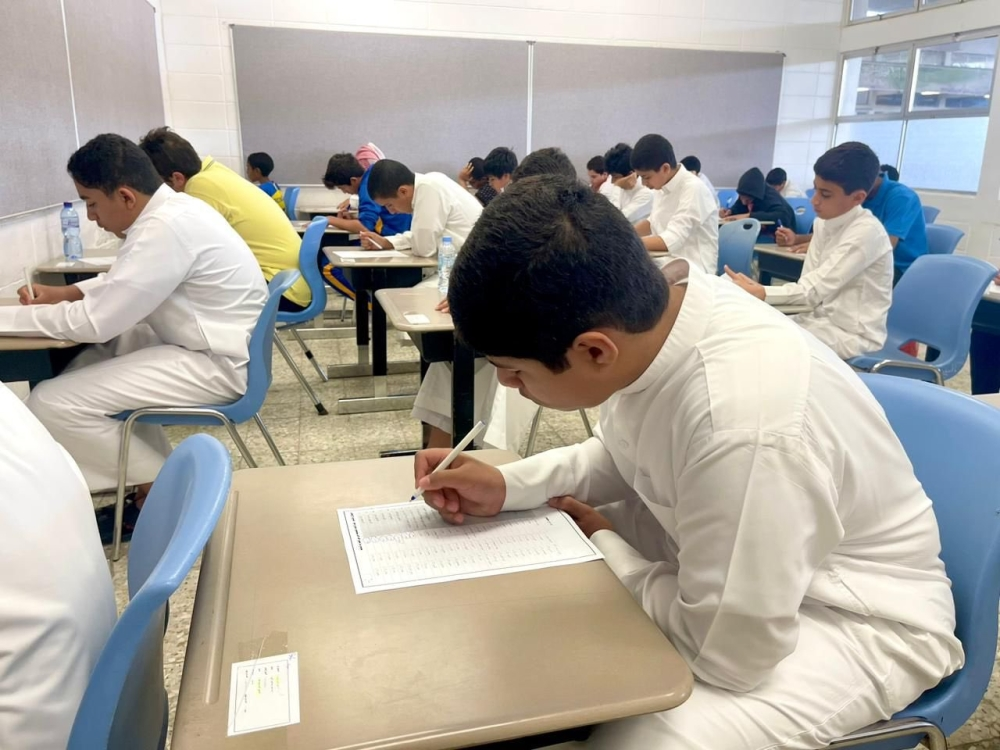
In a move aimed at strengthening school discipline and improving the quality of the educational environment, the Ministry of Education has officially approved linking student behavioral infractions to academic achievement, starting from the third grade of primary school. Under this decision, behavior has become a separate subject with a weight of 100 points, directly impacting the student's overall grade point average. This makes adherence to school regulations a fundamental criterion for success and excellence, alongside core academic subjects.
Context of the decision and its educational objectives
This decision comes as part of the Ministry's ongoing efforts to develop the education system in line with the goals of the Kingdom's Vision 2030, specifically the Human Capacity Development Program, which focuses on instilling values and promoting discipline in young people. Educational experts indicate that the shift from verbal guidance to digital behavior assessment at an early age (third grade) aims to build a responsible student character, where behavior is no longer merely a marginal observation but a fundamental pillar of the educational process.
Grading mechanism: Balance and rewards
Under the new system, third-grade students, who are around nine years old, are held directly responsible for their grades. The system begins by granting each student an automatic credit of 80 points as a "trust bonus" at the start of the semester. However, maintaining this credit requires strict adherence to regulations, as school administrations have the authority to directly deduct points based on the type of infractions committed, according to the approved official guidelines.
It doesn't stop at simply avoiding violations; the new system incentivizes students to demonstrate exemplary behavior to earn the remaining 20 points, which are allocated to positive initiatives and outstanding conduct. Thus, the behavior grade appears independently on the official transcript, becoming a crucial factor that can elevate a student to the ranks of high achievers or lower their overall grade point average, much like the impact of mathematics and Arabic language courses.
Expected impact and compensation mechanism
This system is expected to fundamentally change the relationship between home and school, encouraging parents to monitor their children's behavior more closely to ensure their academic performance is not negatively impacted. To guarantee fairness and equal opportunities, the Ministry has provided a "lifeline" for students who have had grades deducted, in the form of a flexible compensation mechanism.
The compensation mechanism requires the student, with the assistance of their guardian, to provide the student affairs officer with concrete evidence and exemplary behavioral practices demonstrating improved discipline. This evidence is documented to restore the deducted marks to the student's account before the system closes, thus reinforcing the educational concept of assessment rather than mere punishment.
It is worth noting that this strict system excludes first and second grade elementary students, as their behavior continues to be assessed through descriptive and guiding statements without affecting numerical grades, taking into account their age characteristics at this early foundational stage.