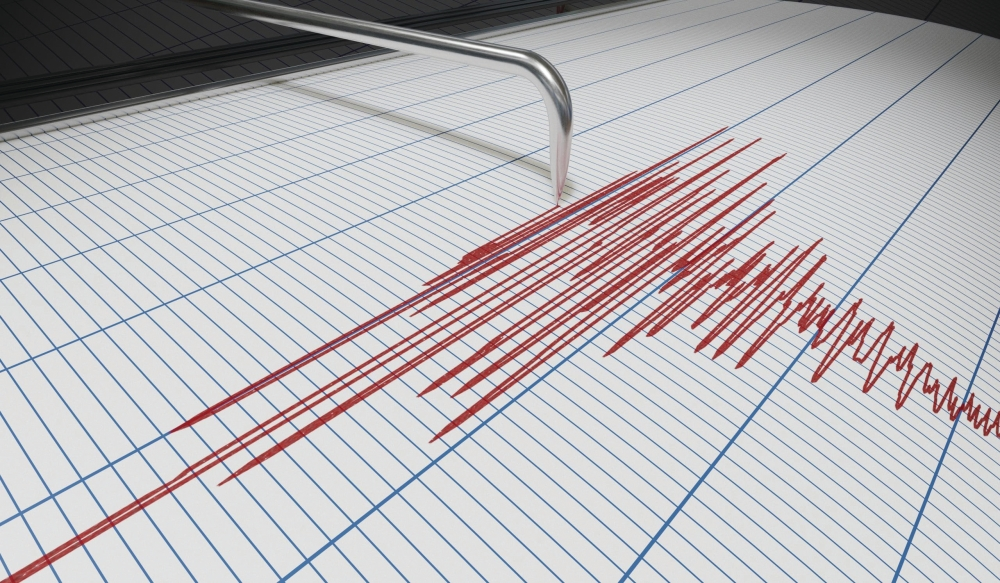
In the early hours of this morning, global and local geological observatories recorded alarming events as earthquakes struck Italian islands in the Mediterranean Sea. These successive tremors caused concern among local residents in coastal areas, especially given the region's history of seismic activity. Despite the strength of the tremors, which were felt by many, divine intervention and the swift response of authorities prevented any immediate reports of loss of life or significant property damage, temporarily reassuring both local and international public opinion.
Details of the aftershocks that followed earthquakes hitting Italian islands
According to official data from the Italian National Institute of Geophysics and Volcanology, an earthquake measuring 4.6 on the Richter scale struck at 2:46 a.m. local time (1:46 GMT). The epicenter was located at a depth of 29 kilometers near the Aeolian Islands in the Tyrrhenian Sea, off the northern coast of Sicily. Just three minutes later, a 4.3 magnitude aftershock struck a nearby area, further heightening concerns.
On the other hand, the U.S. Geological Survey offered slightly different estimates, indicating that the larger earthquake measured 5.2 on the Richter scale and occurred at a relatively shallow depth of only about 10 kilometers. This slight variation in readings is normal in seismology and depends on the location of the monitoring stations. The Italian news agency ANSA confirmed that the 4.3 magnitude tremor was clearly felt by residents of Palermo in Sicily, as well as those in the Reggio Calabria region of mainland Italy, and was followed by a series of weaker aftershocks.
The complex seismic history of the Mediterranean basin
To understand the nature of these phenomena, one must consider the geological context of the region. Italy and the Mediterranean basin are among the most seismically active areas in Europe. This ongoing activity is due to the complex tectonic convergence between the African and Eurasian plates. Historically, Italy, particularly its southern regions and the island of Sicily, has experienced devastating earthquakes that have left a deep mark on the collective memory, such as the infamous Messina earthquake of 1908, one of the worst natural disasters in modern European history.
The presence of active volcanoes such as Mount Etna and Stromboli in the same geographical range as the Aeolian Islands explains the high frequency of earthquakes, as tectonic movement is closely linked to volcanic activity in this unique geographical area, making the region a continuous natural laboratory for geologists.
Regional implications and the importance of continuous monitoring
Earthquakes in sensitive maritime areas are of great importance that extend far beyond Italy's borders. Locally, these events require Italian authorities to raise the level of alert and update public safety protocols, particularly in crowded tourist areas such as the Aeolian Islands and Sicily. Regionally and internationally, monitoring these earthquakes is crucial for all countries in the Mediterranean basin, given the potential for tsunamis in the event of a powerful undersea earthquake.
European and international seismic monitoring centers collaborate closely to exchange real-time data, contributing to the development of effective early warning systems that protect coastlines stretching from southern Europe to North Africa. This international cooperation underscores the importance of continued investment in geological technology and scientific research to mitigate potential risks and ensure the stability of coastal communities that rely heavily on shipping and tourism as key sources of national income.