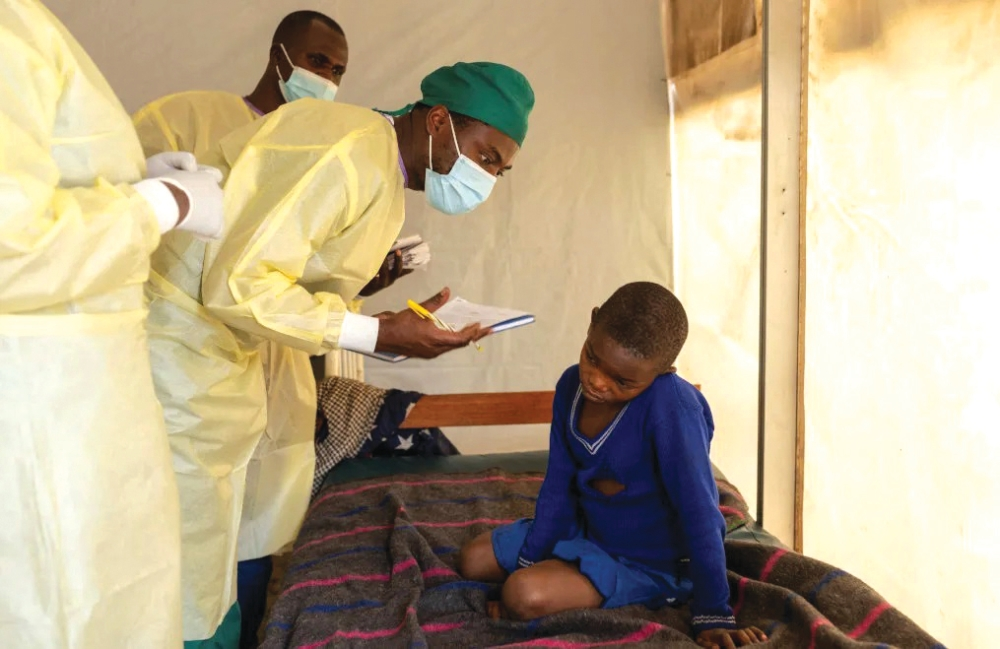
The Democratic Republic of Congo has recorded a remarkable positive development in its fight against the monkeypox (Mpox) outbreak, with the country’s National Institute of Public Health announcing a significant and tangible decrease in the number of new infections, indicating the effectiveness of the health measures recently taken.
Details of the decline in infection rates
According to official data from the institute, the weekly infection rate has seen a dramatic decline. After recording nearly 2,000 cases per week at the peak of the outbreak, the number has now dropped to between 250 and 300. This significant decrease represents a pivotal turning point in the course of the pandemic, which has caused widespread international concern in recent months.
In a press statement, Christian Ngendo, coordinator of the Public Health Emergency Operations Center, explained that the epidemiological map of the virus has shrunk considerably. While the virus was present in 401 health zones at the beginning of the crisis, cases recorded during December were limited to only 19 health zones . Ngendo indicated that the remaining hotspots are mainly concentrated in the North and South Kivu provinces, as well as some areas in Sankoro, making it easier to focus control efforts on these hotspots.
Historical context: Congo, an epicenter of the disease
These figures are particularly significant given the historical background of the disease in the Democratic Republic of Congo. The country is the original home where the virus was first discovered in humans in the 1970s. For decades, Congo has suffered periodic outbreaks, but the latest wave has been the most alarming due to the emergence of new, more transmissible strains, prompting the World Health Organization to declare a global health emergency.
The importance of the event and its regional and international impact
This decrease in infections has important implications that extend beyond the geographical borders of Congo:
- At the local level: This success reflects an improvement in epidemiological surveillance and rapid intervention systems, in addition to the success of community awareness campaigns that contributed to breaking the chains of infection.
- At the regional and international levels, containing the virus in its main epicenter (the Democratic Republic of Congo) is the first line of defense against its spread to neighboring countries and the rest of the world. Controlling the situation at the epicenter means reducing global risks and easing the pressure on international health systems, which have been anxiously anticipating the possibility of the outbreak becoming a widespread pandemic.
Despite this promising news, experts stress the need to remain vigilant and cautious, especially in areas where the virus is still active, to ensure its complete eradication and prevent resurgence.