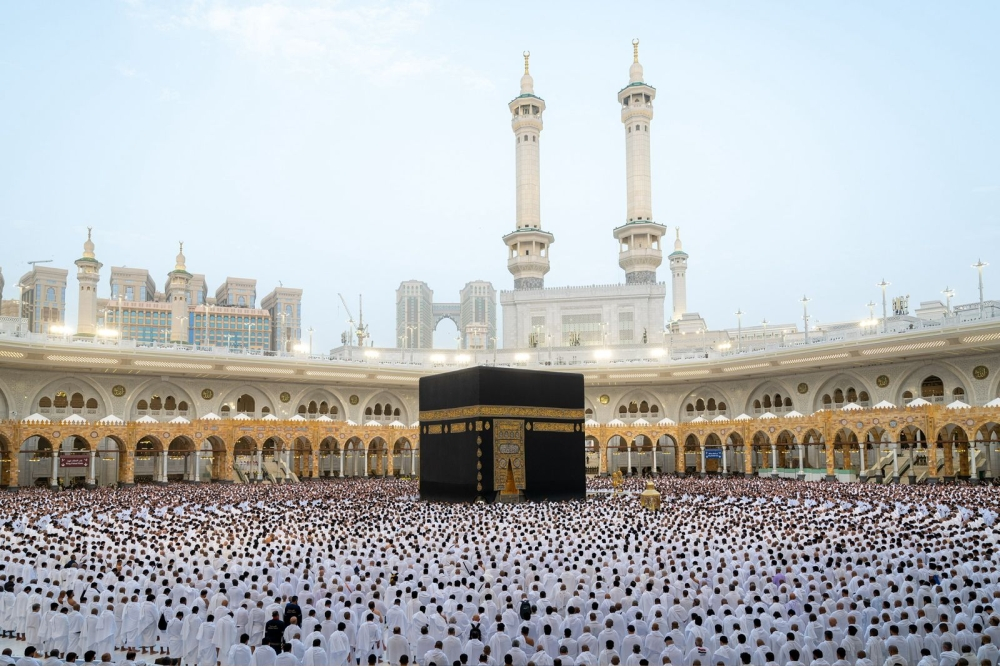
The General Authority for the Care of the Two Holy Mosques announced an exceptional achievement: the success of its operational plan for providing catering services during the holy month of Ramadan. This success culminated in providing of Iftar meals to pilgrims , with the total number of meals distributed exceeding 33,898,092. These intensive and well-planned efforts aimed to provide the utmost comfort and tranquility for pilgrims and worshippers who flocked from all corners of the earth to perform their rituals in a spiritually uplifting atmosphere, surrounded by a comprehensive system of high-quality services.
A historical legacy in caring for pilgrims to the Two Holy Mosques
Providing food and drink to pilgrims visiting the Holy Mosque in Mecca is not a recent development, but rather an extension of a deep-rooted historical and cultural legacy within Islamic history and the history of the Kingdom of Saudi Arabia. For decades, the Saudi leadership has undertaken the responsibility of developing and expanding food and drink services, transforming simple individual initiatives into a massive and organized institutional effort. This historical evolution reflects a firm commitment to serving Islam and Muslims, with the state dedicating all its material and human resources to ensuring the comfort of visitors, making the experience of performing Umrah and visiting the Holy Mosque during Ramadan an unforgettable memory for millions.
An integrated system to provide breakfast meals for the guests of God
During the holy month of Ramadan, the courtyards and halls of the Two Holy Mosques witnessed a coordinated and meticulous system of operations to ensure that Iftar meals reached those in need, adhering to the highest international standards of quality and health and safety. Authorities ensured that the meals provided contained balanced nutritional components that met the needs of those fasting and provided them with the energy required for worship. In addition to nutritional quality, great attention was paid to the smooth flow of movement within the prayer halls and outer courtyards. Well-devised plans were put in place to prevent overcrowding and congestion during the daily distribution process, thus contributing to the safety and security of everyone.
Human and voluntary efforts paint the most beautiful picture of solidarity
Behind these millions of people stand a highly qualified workforce from the Authority, supported by a dedicated team of volunteers who enthusiastically participated in implementing this massive humanitarian initiative. The distribution routes were meticulously organized to ensure efficiency and speed. These tremendous efforts reflect the significant advancements in logistical and technological services that the Kingdom of Saudi Arabia has dedicated to serving the Two Holy Mosques, as well as its continuous monitoring and ongoing efforts to enhance the pilgrims' experience.
The regional and international impact of the Kingdom's humanitarian efforts
The significance of this event transcends the local level, leaving a profound regional and international impact. Locally, these initiatives reinforce the values of social solidarity, generosity, and genuine Saudi hospitality. Regionally and internationally, the successful distribution of over 33 million meals underscores the Kingdom's leadership in crowd management and the provision of humanitarian services on a large scale. The return of millions of pilgrims to their home countries with positive impressions of the level of care and attention they received contributes to enhancing the Kingdom's positive image in the Islamic world and aligns closely with the objectives of Saudi Vision 2030, which aims to enrich and deepen the experience of pilgrims and provide a healthy and safe environment that enables them to perform their rituals with ease and peace of mind.