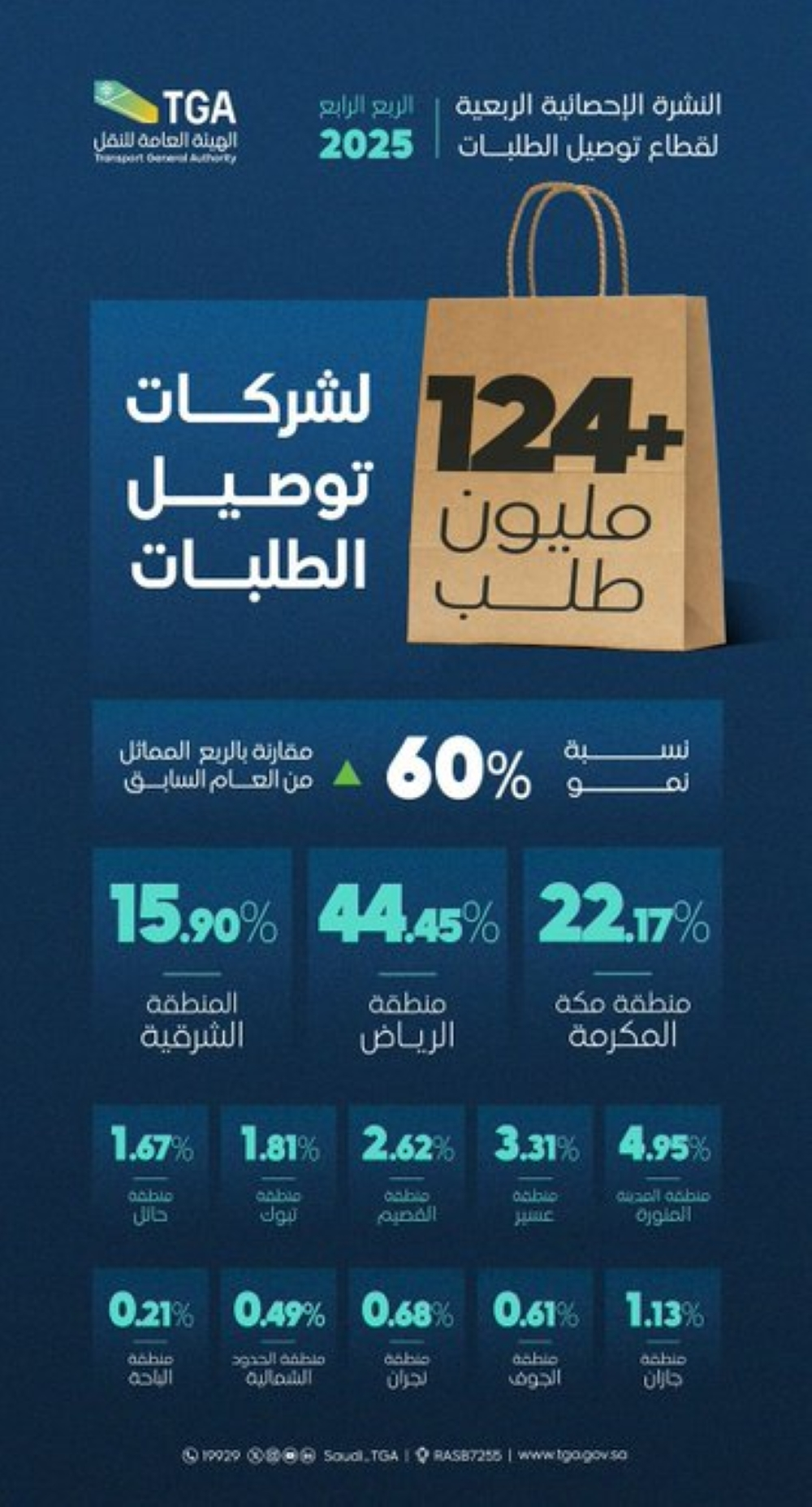
The delivery sector in Saudi Arabia recorded exceptional performance during the fourth quarter of 2025, achieving record figures that reflect the significant boom in the country's logistics and technology sector. According to official data, the total number of orders exceeded 124 million across the Kingdom, marking a remarkable 60 percent increase compared to the same period of the previous year.
Rapid growth and geographical distribution of orders
The statistical bulletin issued by the Public Transport Authority revealed that this significant growth did not occur in a vacuum, but rather is a result of the continuous expansion of digital and logistical infrastructure. The statistics showed a disparity in demand across regions, with the Riyadh region accounting for the lion's share at 44.45% of total demands, reflecting the high population density and commercial activity in the capital. The Makkah region came in second with 22.17%, followed by the Eastern Province with 15.90%.
As for the remaining regions, Madinah recorded 4.95%, Asir 3.31%, Qassim 2.62%, Tabuk 1.81%, Hail 1.67%, and Jazan 1.13%. The remaining percentages were distributed among the regions of Najran, Al-Jawf, the Northern Borders, and Al-Baha, with percentages ranging between 0.68% and 0.21%.
Economic context and Vision 2030
This significant increase in delivery activity aligns with the goals of Saudi Vision 2030, which prioritizes the logistics sector as a key pillar for diversifying the national economy. The National Transport and Logistics Strategy aims to solidify the Kingdom's position as a global logistics hub, with the mobile delivery sector being one of the fastest-growing, fueled by the widespread adoption of smartphones and the development of reliable digital payment systems.
The impact of digital transformation and consumer behavior
Innovative technological solutions have boosted the efficiency of this sector, as the increasing reliance on e-commerce has changed consumer behavior in Saudi Arabia, where consumers now depend more on express delivery services to meet their daily needs, from food and beverages to consumer goods and medicines. This digital transformation has not only made life easier for citizens and residents but has also created huge investment opportunities for startups and entrepreneurs in the technology and logistics fields.
In conclusion, this positive momentum is expected to continue in the coming years, as the Public Transport Authority continues to regulate the sector and enact legislation that ensures service quality and the rights of beneficiaries, thus enhancing the attractiveness of the Saudi market as a fertile environment for the growth of digital platform economies.