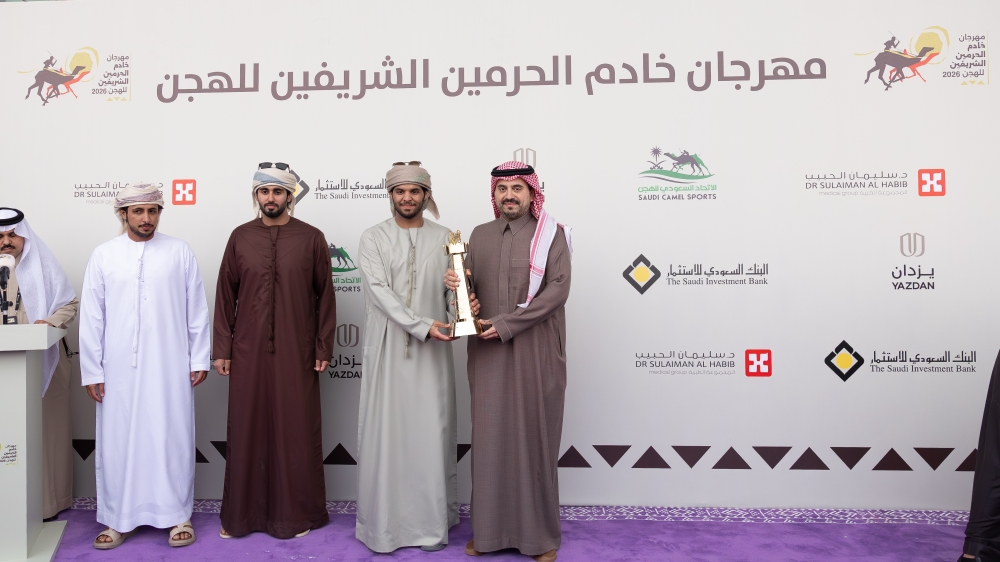
In a traditional atmosphere filled with enthusiasm and fair competition, His Highness Prince Fahd bin Jalawi bin Abdulaziz bin Musaed, Chairman of the Board of Directors of the Saudi Camel Racing Federation, crowned the Emirati owners who won the cups of the Custodian of the Two Holy Mosques Camel Festival in its third edition, at the conclusion of the "Haqayiq" category competitions, which witnessed a strong struggle between the elite of the Gulf camels.
The events were launched under the generous patronage of the Custodian of the Two Holy Mosques, King Salman bin Abdulaziz Al Saud – may God protect him – at the historic Janadriyah Square in Riyadh. This square holds deep historical significance, having witnessed decades of races that brought together the people of the Gulf Cooperation Council countries, thus reinforcing the festival's status as one of the most important heritage sporting events in the region.
Emirati dominance in the trophies and Saudi superiority in points
The main races witnessed a remarkable performance from Emirati camels, with "Bayna," owned by Maneh Al Shamsi, winning the first race and the festival cup in the (Bakar - Open) category, recording the best time in the competition at 5:50.969 minutes. "Mahkam," from the UAE Presidential Camel Racing Team, won the (Qadan - Open) cup, while "Saba," owned by Mohammed Al Ketbi, won the (Bakar - General) cup, and "Al Hilali," owned by Hamad Al Ameri, won the (Qadan - General) cup.
Despite the UAE camels snatching the main cups, Saudi owners maintained their control over the overall results of the competitions, with Saudi camels topping the list with 59%, achieving first place in 38 out of 64 races held on the first and second days, reflecting the great development witnessed by the camel sector in the Kingdom and the unlimited support that owners receive.
Economic and cultural dimensions of the festival
The importance of the Custodian of the Two Holy Mosques Camel Festival extends beyond mere competition to encompass significant economic and cultural dimensions. With substantial prize money exceeding 75 million riyals, the festival stimulates the camel market and supports owners and trainers in preserving purebred Arabian camel lineages.
This event comes to emphasize the cultural identity of the Kingdom and the Gulf countries, as camel racing is an integral part of the popular heritage (intangible heritage) that the Kingdom seeks to establish globally within the Kingdom’s Vision 2030. The rest of the results were distributed to reflect this Gulf unity, as the Emirati camels achieved 13 races, and the Omani and Qatari camels were equal with 4 races each, followed by Kuwait with 3 races, and Bahrain with 2 races.
It is worth noting that the festival lasts for 10 days, including 225 races of varying distances, in addition to camel races for men and women and beauty contests, making it an integrated tourist and sports destination that attracts visitors and lovers of this ancient sport from all over the world.