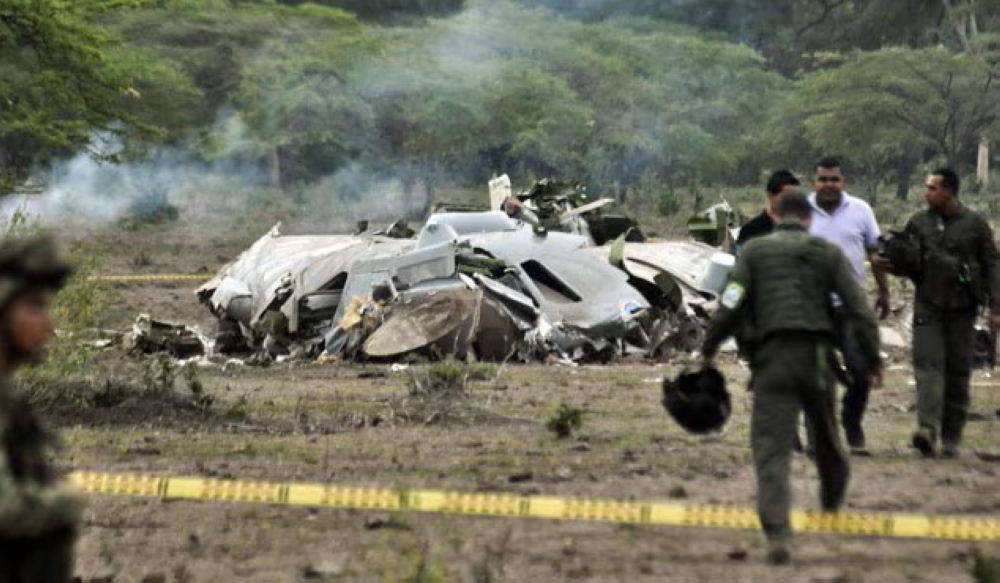
The Colombian army announced on Monday a major military tragedy: the death of approximately 80 soldiers in a transport plane crash in southern Colombia . This tragic incident has sent shockwaves both domestically and internationally, given the heavy loss of life within the armed forces. A well-informed military source reported that members of two entire battalions, estimated at 80 soldiers, are believed to have been aboard a C-130 Hercules military transport plane. The source explained that the crash occurred during takeoff from the military base in Puerto Leguizamo, a strategic area located near the country's southern border with Ecuador.
Details of the transport plane crash in southern Colombia
The crash of a transport plane in southern Colombia is considered one of the worst air disasters to befall the Colombian armed forces in its recent history. The Hercules aircraft involved in the crash is a heavy tactical transport plane that Colombia relies on heavily for transporting troops and equipment to remote areas. The accident occurred at a critical moment—during takeoff—raising numerous questions about the possible causes, including sudden engine failure, overloading, or the harsh weather conditions characteristic of that tropical region. Rescue and investigation teams are currently working to recover the victims and analyze the two black boxes to determine the precise cause of the crash.
Security context and geographical challenges in Puerto Leguizamo
To understand the dimensions of this incident, one must consider the geographical and security nature of the region. Puerto Leguizamo is located in the Putumayo Department, an area covered by dense Amazon rainforest and lacking secure road infrastructure. Historically, this border region with Ecuador and Peru has been the scene of complex operations against illegal armed groups, such as FARC dissidents and drug cartels. Due to these geographical and security challenges, the Colombian military relies almost entirely on air transport to move its troops and supply its military bases. Therefore, the loss of a Hercules aircraft represents a significant blow to the logistical capabilities of the armed forces in this vital region.
Expected repercussions and effects of the air disaster
This tragic incident has far-reaching consequences on multiple levels. Domestically, the loss of 80 soldiers has left a profound psychological impact on the victims' families and on the morale of the Colombian army, which is engaged in ongoing operations to maintain security. Regionally, the temporary reduction in logistical capacity in this sensitive border region could be exploited by transnational criminal groups to intensify their illegal activities, necessitating a heightened security mobilization by Colombian authorities in coordination with neighboring Ecuador.
Internationally, this incident highlights the challenges facing developing countries in maintaining and modernizing their military air fleets. This event may prompt the Colombian government to seek additional international support for modernizing its military equipment, or to review its maintenance and safety protocols for military transport aircraft in collaboration with manufacturers and international experts to ensure such tragedies are not repeated in the future.