The Taiwan Strait witnessed a new military escalation, with Beijing and Taipei exchanging heated statements regarding the results of the massive military exercises conducted by the Chinese army. While Taiwan declared the drills, which simulated a siege of the island, a failure, Beijing asserted that its forces successfully achieved their objectives using live ammunition.
Details of the maneuvers and the Taiwanese response
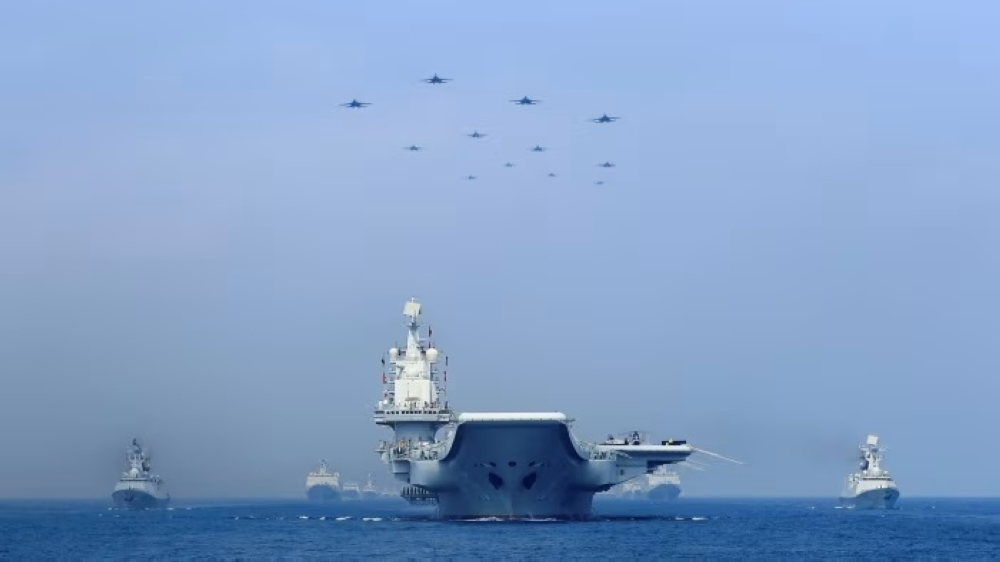
Taiwan's Ministry of Defense announced the detection of unprecedented military activity, recording the presence of at least 130 Chinese military aircraft and more than 50 warships near the island, the highest number recorded in a single day since mid-October 2024. Despite this large buildup, Hsieh Jie-sheng, the intelligence official at Taiwan's Ministry of Defense, downplayed the effectiveness of these movements, asserting that Beijing's intention to impose a blockade had not materialized, based on reports from the Taiwanese Coast Guard.
In response, the Chinese military issued an official statement confirming that the ground forces of the People's Liberation Army's Eastern Theater Command had conducted precise long-range live-fire drills in the northern waters of Taiwan, stressing that these operations had accurately achieved their strategic objectives.
Conflict context and strategic importance
These maneuvers come amid a long-standing historical tension between the two sides, with China considering Taiwan an integral part of its territory and vowing to annex it, by force if necessary, while Taiwan maintains its self-governance and democratic system. These events are of paramount international importance given the strategic location of the Taiwan Strait, a vital waterway for global trade, and Taiwan's pivotal role in the global semiconductor industry.
Observers believe that Beijing's intensification of its military maneuvers aims to exert continuous psychological and military pressure on the new Taiwanese leadership, and to test the readiness of Chinese forces for naval and air blockade scenarios, which raises concerns in the international community about the possibility of a miscalculation that could lead to a large-scale conflict.
Presidential condemnations and international concern
Taiwanese President Lai Ching-te strongly condemned China's actions, describing them in a Facebook post as a "blatant provocation of regional security and the international order." Lai asserted that China is disregarding the world's aspirations for peace and deliberately undermining stability, while simultaneously emphasizing his commitment to acting responsibly to avoid escalation.
Internationally, European powers were quick to express their concern. The European External Action Service spokesperson, Anita Heber, called on Beijing to exercise restraint, stressing that peace in the Taiwan Strait is a cornerstone of global security and prosperity. France and Germany also joined the chorus of critics, with Berlin warning that the maneuvers increase tensions and undermine stability, while Paris urged all parties to refrain from escalation.
Missiles in the skies over the strait
On the ground, Taiwanese authorities detected the launch of 27 Chinese missiles during the exercises. Media reports indicated that China launched a barrage of missiles, leaving trails of white smoke in the sky and creating a loud noise that caught the attention of residents and tourists in nearby areas, reflecting the heightened tensions in the region.