In a serious diplomatic escalation reflecting heightened tensions between the two superpowers, the People's Republic of China on Sunday demanded the immediate and unconditional release of Venezuelan President Nicolás Maduro by the United States. This firm stance followed a US military operation in the Venezuelan capital, Caracas, which resulted in Maduro's arrest and transfer to US soil.
The Chinese Foreign Ministry issued a strongly worded statement calling on Washington to "guarantee the personal safety of President Nicolás Maduro and his wife and release them immediately," stressing the need to cease attempts at regime change by force in Venezuela. Beijing described the US operation as a "flagrant violation of international law" and diplomatic norms governing relations between sovereign states, warning of the serious repercussions of this action on global stability.
Details of arrival in New York and the upcoming trial
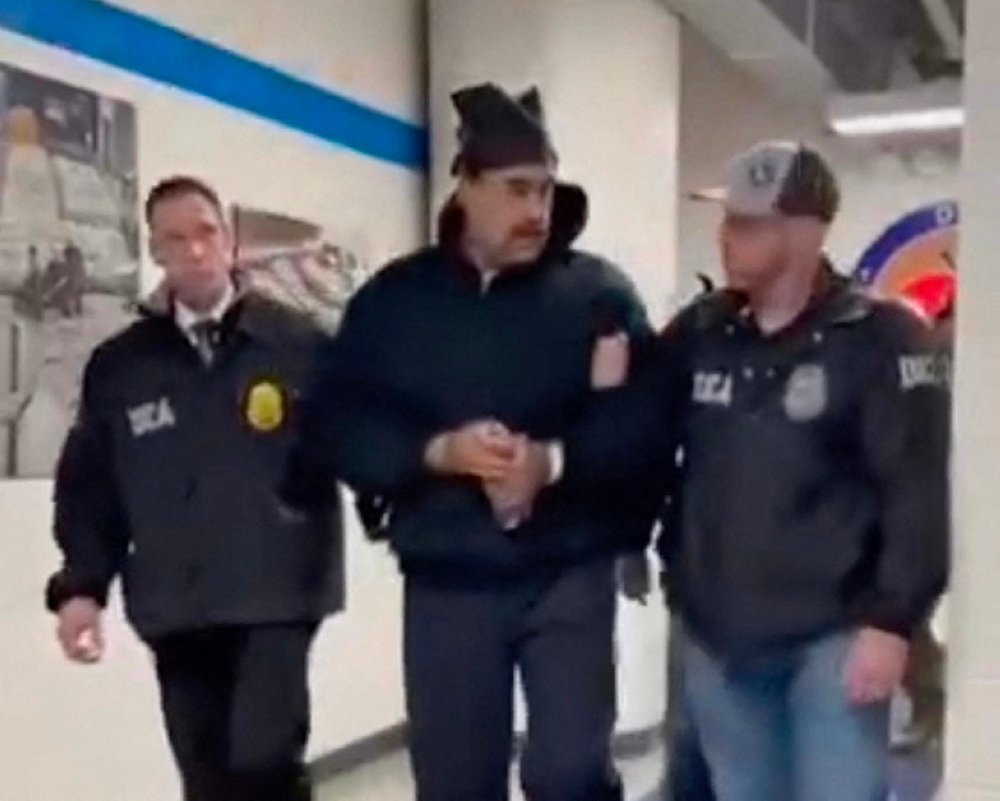
On the ground, international news agencies captured the moment Venezuelan President Nicolás Maduro arrived in the United States on Saturday. Images showed Maduro disembarking from a plane at Stewart International Airport in upstate New York, surrounded by a heavy US security detail. Reports indicate that Maduro will be transported by helicopter to New York City to face trial on serious charges related to drug trafficking and alleged terrorism—charges the US administration has long leveled against the regime in Caracas.
Constitutional procedures in Caracas to fill the void
In an attempt to salvage the situation and ensure the continued functioning of state institutions, Venezuela's Supreme Court acted swiftly. The Constitutional Chamber issued an order appointing Vice President Delcy Rodríguez as interim president. The court stated that Rodríguez would assume "all responsibilities, duties, and powers of the office of President of the Republic" in order to "guarantee the continuity of administration and the overall defense of the homeland" against what it described as foreign aggression. Notably, the judges did not declare Maduro "permanently absent," a legal procedure that would have mandated early elections within 30 days, indicating the regime's continued adherence to Maduro's legitimacy despite his detention.
Background to the conflict: sanctions and mutual accusations
This momentous event cannot be separated from the context of historically strained relations between Washington and Caracas. For years, the United States has imposed harsh economic sanctions on Venezuela, targeting its vital oil sector and key government figures. The current accusations date back to 2020, when the US Department of Justice formally charged Maduro and several of his associates with "terrorism and drug trafficking," offering a $15 million reward for information leading to his arrest. Washington maintains that Maduro's government operates what it calls the "Cartel of the Suns," smuggling drugs into the United States—an accusation Caracas has repeatedly denied, dismissing it as a pretext for colonial intervention.
Geopolitical dimensions and the Chinese position
China's position is particularly significant given the strategic relationship between Beijing and Caracas. China is one of Venezuela's largest creditors and a major trading partner in the energy sector. Beijing views the direct US military intervention to arrest the head of a sovereign state as a dangerous precedent that threatens the principle of "non-interference in internal affairs," a cornerstone of Chinese foreign policy. Observers believe this event could lead to a new international alignment, with Russia and other Venezuelan allies expected to join China in condemning the operation, potentially transforming the Venezuelan crisis into a major international conflict extending beyond Latin America.