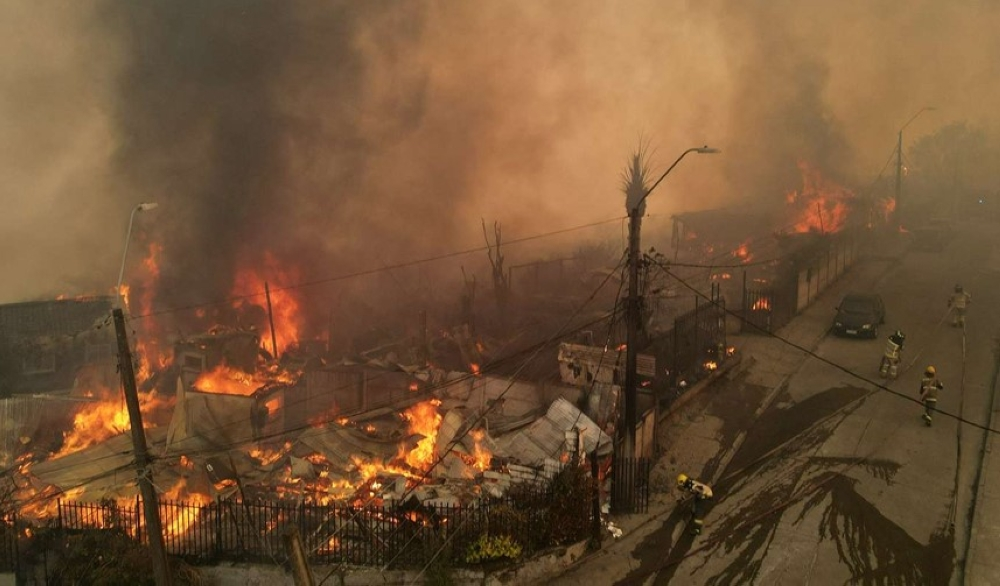
Wildfires continue to rage across vast areas of forests and residential regions in southern Chile, creating a worsening environmental and humanitarian disaster that has already claimed at least 19 lives. With the fires still burning out of control, authorities have declared a state of maximum alert, warning that extreme weather conditions could further exacerbate the situation.
Developments on the ground
Alicia Cebrayan, director of the National Disaster Prevention and Response Agency (Cenabrede), confirmed in a press statement that "the largest fires are still out of control," noting the difficulty of firefighting operations due to the rugged terrain and the rapid spread of the flames. These fires broke out on Saturday in the departments of Nuevo and Vióvio , located approximately 500 kilometers south of the capital, Santiago.
This disaster comes at the height of the southern summer, where high temperatures exceeding 30 degrees Celsius, strong winds, and low humidity combine to create an ideal environment for fires to spread at an enormous speed, turning homes and cars to ash in a matter of minutes.
Government measures and a state of emergency
In response to the disaster, the Chilean government declared a state of emergency in the affected provinces, a constitutional measure that allows for the deployment of military forces to assist with evacuations and security, as well as to provide the necessary logistical resources to combat the fires. A nighttime curfew was also imposed in the worst-affected areas of Viuvio to ensure the safety of citizens and prevent potential looting.
Gabriel Burik visited the affected areas to directly oversee firefighting operations, and stated via the "X" platform that weather conditions were still unfavorable, expressing his concern about the resurgence of partially contained hotspots.
Environmental and climatic context
These fires are part of a recurring and alarming pattern in Chile in recent years. The South American country has been suffering from a prolonged drought for over a decade, which scientists clearly link to global climate change. This drought has made forests more flammable, with vast areas of vegetation becoming dry fuel for the fires.
Environmental reports indicate that the recurring extreme heat waves and high wind intensity in the south-central region of Chile have increased the frequency and severity of forest fires, placing enormous pressure on fire crews and local infrastructure.
Tragedies of the population and destruction
On the ground, residents are living through moments of sheer terror. The damage was particularly concentrated in the towns of Pinco and Lercuín, near the city of Concepción. In a harrowing account to AFP, Yagora Vásquez, a survivor, said: "The situation is horrific. I tried to keep the house as cool as possible, but I saw the flames approaching our neighborhood. I grabbed my son and we ran.".
As dawn broke on Monday, the extent of the disaster became clear, with scenes of widespread destruction overshadowing residential neighborhoods, amid fears of a rising death toll and heavy economic losses for the region's agriculture and forestry sectors.