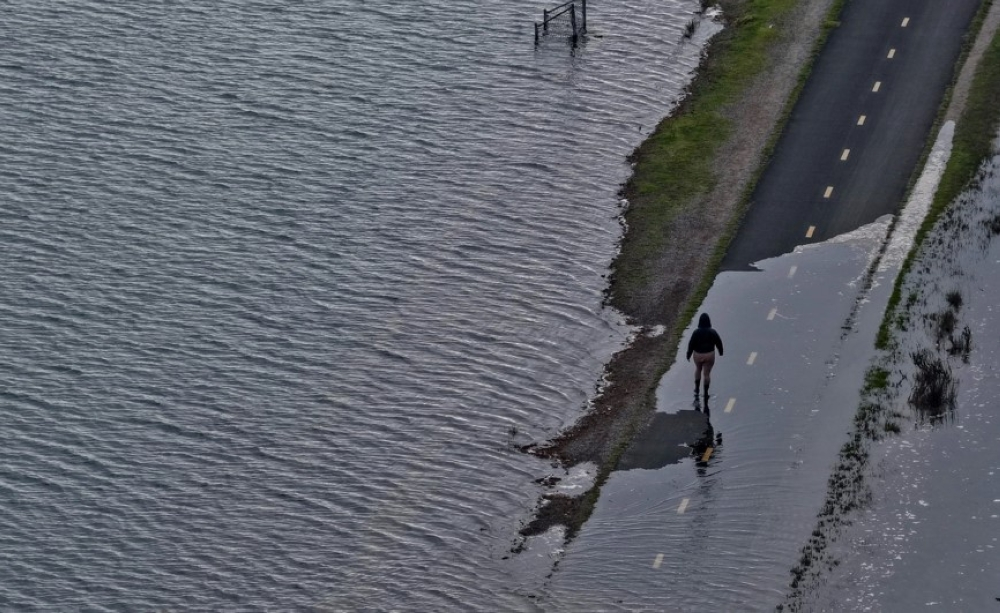
US authorities today renewed their urgent warnings to residents of Southern California about the imminent dangers of widespread flooding and dangerously high river levels. This comes as a result of continuous heavy rainfall, which is not expected to stop during the holiday season, placing the region under exceptional weather stress.
These warnings came a day after a state of emergency was officially declared in Los Angeles and most of the southern part of the state, in a proactive step aimed at mobilizing the necessary resources to confront potential disasters.
The phenomenon of "air river" and its climatic impact
The US National Weather Service explained that the state is experiencing what is scientifically known as an "atmospheric river," a narrow, elongated passage in the atmosphere that carries enormous quantities of water vapor from the tropics. This weather phenomenon is capable of releasing rainfall equivalent to the flow of the Mississippi River at its mouth, making it a major cause of major flooding on the US West Coast.
This phenomenon is doubly dangerous this year due to its coinciding with the holiday season, which complicates transportation and travel, and places additional burdens on rescue and emergency teams working around the clock to monitor dams and rivers.
Risk of landslides in areas of previous fires
In a related development, the agency issued a strong warning about the potential for “serious and potentially fatal flash floods,” with particular emphasis on areas previously affected by wildfires. In these areas, the soil has lost its ability to absorb water due to the burning (a condition known as hydrophobic soil), instantly transforming heavy rainfall into torrents of mud, debris, and rocks, posing a direct threat to homes located on or below slopes.
Declaration of Emergency and General Context
In response to these threats, California Governor Gavin Newsom declared a state of emergency in several counties, including Los Angeles and San Diego. This declaration allows the state rapid access to federal resources and the deployment of National Guard troops, if needed, to assist in evacuations and rescue operations.
Climate experts point out that California has experienced extreme weather fluctuations in recent years, oscillating between prolonged droughts and devastating wildfires, followed by periods of torrential rain. This extreme pattern is partly attributed to global climate change, which is intensifying weather events and placing the state's infrastructure under increasingly severe and frequent tests that require long-term adaptation strategies.