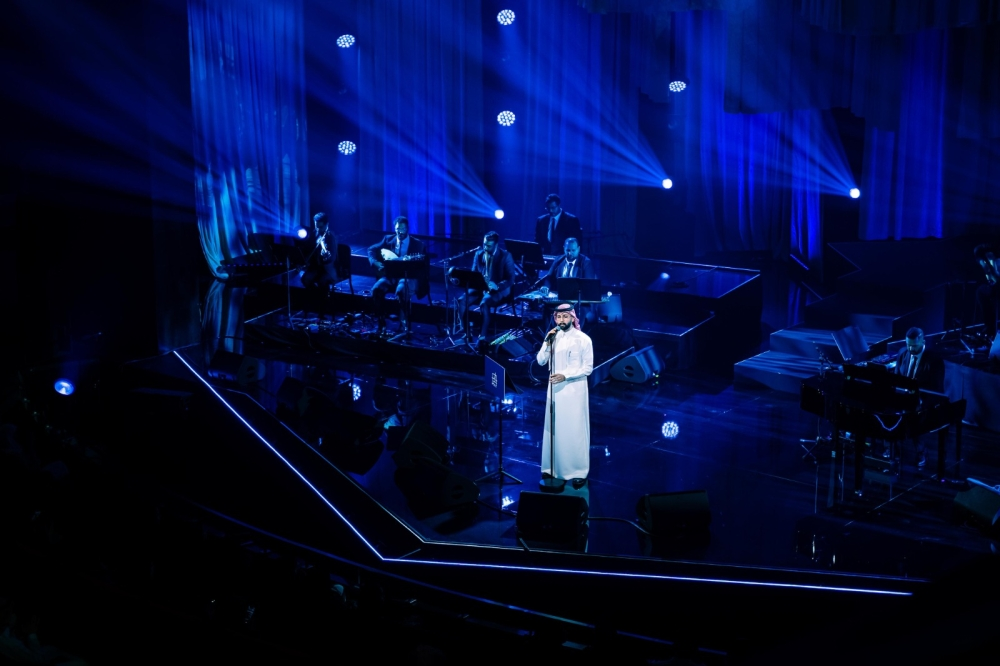
Young Saudi artist Bader Hakim expressed his immense joy at participating in the "Singing in Classical Arabic" evenings held at the King Abdulaziz Center for World Culture (Ithra), describing the experience as "fantastic and exceptional" in every detail. Hakim emphasized that the atmosphere was imbued with grandeur and sophistication, and that performing in a cultural landmark as significant as Ithra instills in an artist a sense of pride and responsibility towards the Arabic language and its timeless beauty.
Reviving a rich heritage with a contemporary vision
Singing in Classical Arabic is not a new phenomenon; rather, it is an extension of a great artistic heritage that has shaped the conscience of the Arab nation for decades. The voices of the greatest Arab artists have resonated with the most beautiful poems, from Umm Kulthum in "Al-Atlal" and "Aghadan Alqak," to Abdel Halim Hafez in "Qari'at Al-Finjan" and "Risala Min Taht Al-Ma," passing through the angelic voice of Fairouz, who sang the works of Khalil Gibran and Said Akl, and culminating in Kadim Al-Saher, who was dubbed the "Caesar of Arabic Song" for his adoption of Classical Arabic poetry as a comprehensive artistic project. The "Singing in Classical Arabic" initiative, organized by the Music Authority in cooperation with Ithra, comes to complete this path, presenting it to the new generation in a modern style that combines authenticity and modernity, thus ensuring the continuity of this refined art.
The importance of the initiative and its cultural impact
This initiative is particularly significant within the context of the cultural transformations underway in Saudi Arabia, as part of Vision 2030, which aims to enrich local content and strengthen cultural identity. Locally, these events open new horizons for young Saudi artists like Bader Hakim, providing them with a prestigious platform to showcase their talents and connect with an audience that appreciates fine art. Regionally, these evenings work to strengthen cultural ties between Arab countries by celebrating the most important common denominator—the Arabic language—and encouraging artists across the Arab world to rediscover the treasures of Arabic poetry and present them in innovative musical forms.
A unique experience and an unforgettable interaction
In his remarks, Hakim explained that Classical Arabic holds a special appeal for a wide segment of the audience, and that performing it in a fitting setting amplifies its impact. He said, “The experience is truly beautiful, and literally surrounded by all the meanings of luxury and sophistication. When an artist sings in Classical Arabic in a place like Ithra, the feeling is beyond description.” Hakim praised the audience’s overwhelming response, describing it as “wonderful and generous,” especially with his new song, which he performed for the first time. He added, “They honored me greatly with their interaction, especially with my new song, which hasn’t even been released yet. Their applause was something I will never forget.”.
Classical Arabic... a language that reaches every heart
Regarding the ability of classical Arabic songs to reach young people, Hakim emphasized that the simplicity and clarity of the lyrics allow their emotion to resonate directly with the heart. He explained, “Classical Arabic songs always convey emotion because they are clear, accessible, and uncomplicated. When an artist performs them, they feel that they reach everyone in the Arab world, not just the audience of one country.” Hakim considered his first performance at the Ithraa Theater a significant milestone in his artistic career, affirming that it was a “fantastic” memory that will stay with him forever, reinforcing his belief in the importance of refined language in creating timeless art.