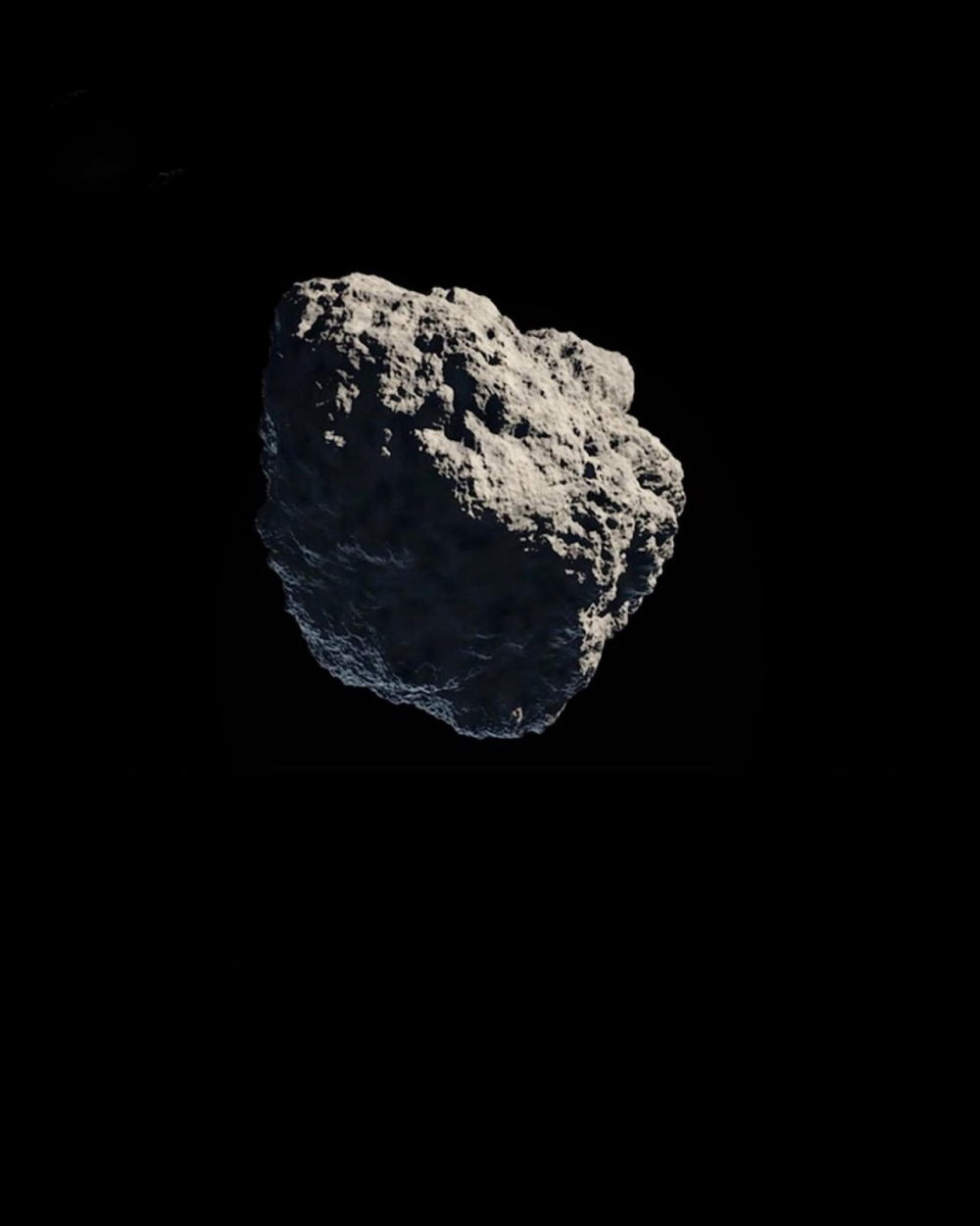
The scientific community and astronomy enthusiasts around the world are eagerly awaiting a significant astronomical event today, Sunday, with the passage of the newly discovered asteroid, designated "2025 WM4," close to Earth. Although its passage will be at a very close distance by astronomical standards, all orbital calculations and data from global space agencies, most notably NASA and the Jeddah Astronomical Society, confirm that this passage is completely safe and poses no threat to our planet.
The asteroid will reach its closest point to Earth at a distance of approximately 271,548 kilometers. To put this into perspective, this distance is 30% less than the average distance between the Earth and the Moon, placing it in the category of "near-Earth objects" (NEOs), which are objects that are under constant and precise observation by a global network of observatories and telescopes.
The scientific context and the importance of monitoring near-Earth objects
Near-Earth objects (NEOs) are defined as asteroids or comets whose orbits are influenced by planetary gravity, bringing them closer to Earth's orbit. Space agencies prioritize monitoring and tracking these objects through specialized programs such as NASA's Planetary Defense Coordination Office. The goal of this monitoring is not only to understand our cosmic environment but also to identify any potential future collision risks, however small, and develop strategies to mitigate them. Historical events like the 2013 Chelyabinsk asteroid explosion in Russia, which measured approximately 20 meters in diameter, serve as a reminder of the importance of constant vigilance. That event injured hundreds due to its shockwave and shattered windows.
Details of the asteroid “2025 WM4” and assurances from experts
Engineer Majed Abu Zahra, head of the Jeddah Astronomical Society, explained that the asteroid “2025 WM4” is relatively small, with an estimated diameter of only about 17 meters. He emphasized that this tiny size means that even in the highly unlikely hypothetical scenario of it entering the atmosphere, it would disintegrate and burn up before reaching Earth's surface, most likely producing a bright fireball (meteor) that could be seen, without causing any significant damage. Abu Zahra added that this safe passage represents a valuable scientific opportunity and not a cause for fear, urging the public to rely on credible scientific sources and avoid rumors that may circulate on social media.
The importance of the event to the international scientific community
Far from being merely a curious event, the passage of an asteroid like 2025 WM4 presents a golden opportunity for scientists. It allows them to test and refine their computer models of celestial bodies' trajectories, thus increasing the accuracy of future predictions. It also enables ground-based observatories, using radar and optical imaging techniques, to gather vital data about the asteroid's physical properties, such as its precise size, shape, rotation speed, and rock composition. This information is invaluable for planetary defense efforts, contributing to the development of a comprehensive database that aids in planning any future interception mission, should the need arise, similar to the successful DART mission that demonstrated humanity's ability to alter an asteroid's trajectory.
In conclusion, the safe passage of this space visitor reflects the ability of modern science to transform the unknown into knowledge, and highlights the importance of international cooperation in protecting our planet, turning an event that would have been a cause for concern in the past into an opportunity for scientific learning and discovery.