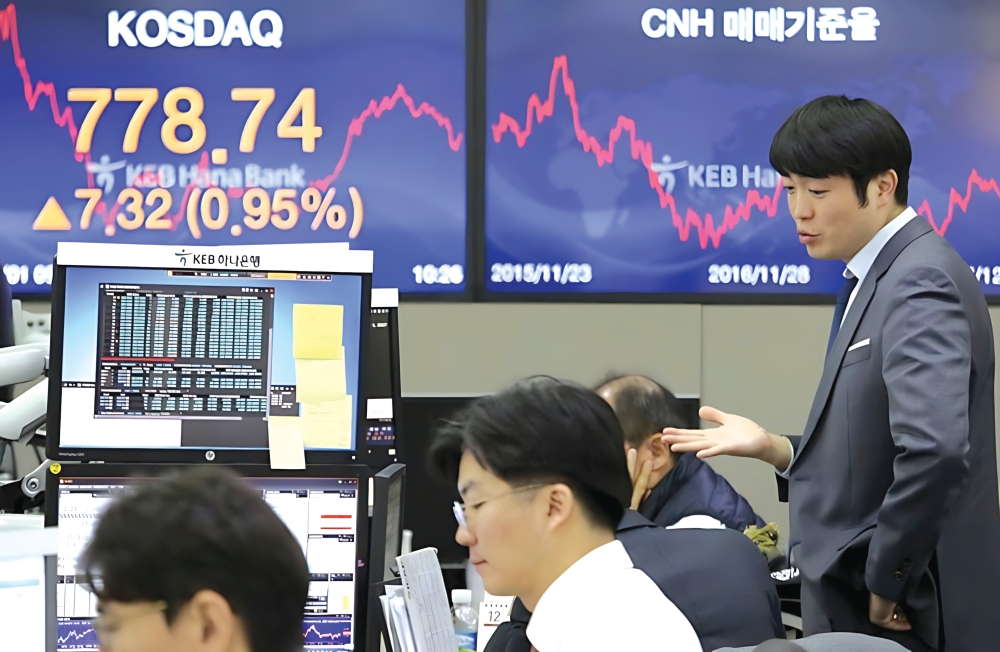
Global financial markets were rocked by another shock as Asian stocks plunged in early trading on Monday. South Korea's Kospi index led the negative performance, registering a significant 5% drop. This sudden decline has unsettled investors and prompted them to reassess their portfolios amid the volatility of global markets.
The losses weren't limited to the Korean market; the wave of declines extended to major stock exchanges across the region. At one point during trading, the Korean Kospi index plummeted by as much as 6.3% before recovering some of its losses. In Japan, the Nikkei 225 index fell by 4.3% to 51,088.30 points. Hong Kong's Hang Seng index lost approximately 2.8%, settling at 24,580.11 points, while China's Shanghai Composite index declined by nearly 2% to 3,879.86 points.
The economic context behind the decline in Asian stocks
To understand the reasons behind the decline in Asian stocks , it's necessary to consider the broader context and historical background of the region's financial markets. Historically, Asian stock exchanges have been highly sensitive to US economic decisions, particularly those related to interest rates set by the US Federal Reserve. When interest rates rise or economic data indicates a slowdown in global growth, investors tend to liquidate their high-risk assets, such as stocks in emerging and Asian markets, and seek safe havens.
In addition, ongoing geopolitical tensions and commodity price volatility play a pivotal role in shaping capital flows. The technology sector, which carries significant weight in indices such as the Korean and Taiwanese Kospi, is often the first casualty of any disruptions to global supply chains or a decline in global consumer demand, explaining the sharpness of the declines we are witnessing today.
Expected impacts on local and global markets
The significance of this event extends far beyond the red numbers on trading screens, impacting multiple levels. Locally and regionally, this sharp decline is eroding investor and business confidence, potentially slowing new investments and negatively affecting economic growth in countries like South Korea, Japan, and China. Furthermore, the drop in valuations of major companies could lead to a reduction in expansion and hiring plans.
Internationally, Asian markets are often considered an early indicator of trends in European and American markets due to time zone differences. Sharp declines in Asia frequently pave the way for negative openings on the London, Frankfurt, and Wall Street stock exchanges. Furthermore, the stock market downturn reflects deeper concerns about the health of the global economy, placing additional pressure on central banks and monetary policymakers to intervene to stabilize markets and prevent a widespread recession.