A wave of widespread condemnation from the Arab and Islamic world
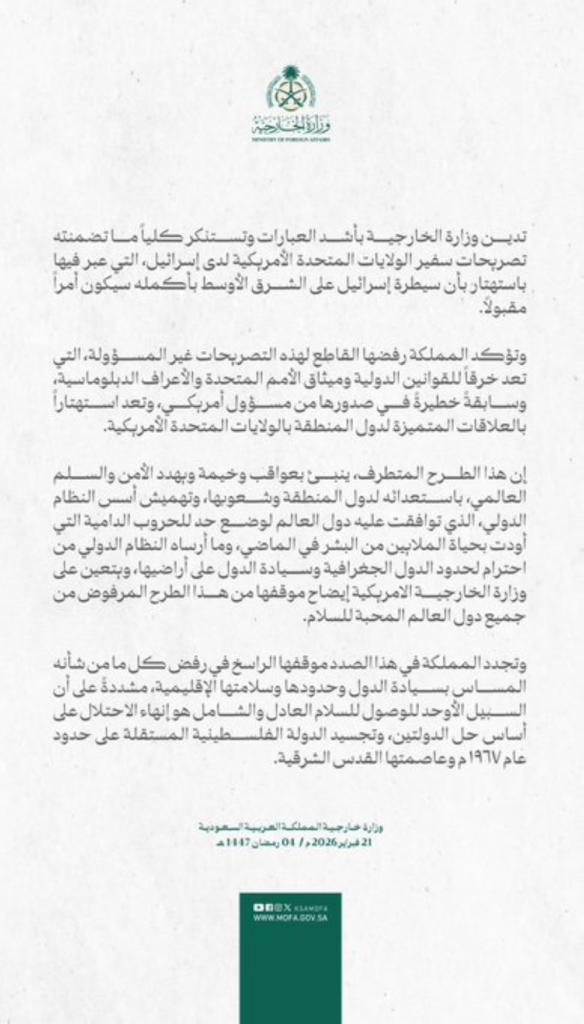
Statements made by the US ambassador to Israel sparked widespread anger and condemnation, with the foreign ministries of Saudi Arabia, Jordan, the UAE, Qatar, Egypt, Kuwait, Oman, and Bahrain, as well as Palestine, Turkey, Indonesia, Pakistan, Syria, and Lebanon, issuing strongly worded statements. Major regional organizations, including the Arab League, the Organization of Islamic Cooperation, and the Gulf Cooperation Council, joined in these condemnations, expressing their categorical rejection and deep concern over the remarks.
The rejected statements centered on the ambassador’s suggestion of accepting Israeli control over Arab lands, including the occupied West Bank, which countries and organizations considered a serious deviation from established international positions and the principles of international law.
The historical and legal context of the conflict
The condemnations are based on a well-established historical and legal foundation. Since the 1967 war, the United Nations and the international community have considered the West Bank, including East Jerusalem, the Gaza Strip, and the Syrian Golan Heights to be occupied territories. Numerous UN Security Council resolutions, most notably Resolutions 242 and 338, affirm the inadmissibility of the acquisition of territory by force and call for Israel’s withdrawal from the occupied territories. Israeli settlements established on these territories are also considered illegal under international law, specifically the Fourth Geneva Convention. Therefore, any statement that legitimizes this reality directly undermines the foundations of the international legal order governing the conflict.
The importance and expected impact of the statements
The danger of these statements lies in their multifaceted impact. Domestically , they exacerbate the frustration of the Palestinian people and undermine their confidence in any future US-sponsored peace process, while also emboldening extremist elements in Israel to pursue annexation and settlement expansion policies. Regionally , these positions threaten to destabilize the region, weaken the efforts of moderate Arab states seeking a just and peaceful solution, and could further inflame public anger. Internationally , such statements place the United States at odds with its European allies and most of the world, which remains committed to a two-state solution based on the 1967 borders, thus weakening the international consensus necessary for resolving the conflict.
Affirmation of principles and categorical rejection of violations
The statements issued stressed that these provocative remarks constitute a flagrant violation of the UN Charter and resolutions of international law, and seriously undermine the prospects for peace. The states and organizations reaffirmed their firm and unwavering position rejecting any Israeli sovereignty over the occupied Palestinian and Arab territories, and strongly opposing any unilateral steps to annex the West Bank or expand settlement activity. They warned that the continuation of these illegal policies and measures will only fuel further violence and conflict in the region. They also renewed their full commitment to supporting the inalienable rights of the Palestinian people, foremost among them their right to self-determination and the establishment of their independent state with East Jerusalem as its capital, and the end of the occupation of all Arab territories.