The World Cup's glory returns: Qatar to host the 2025 Arab Cup
Arab football fans are once again turning their attention to Qatar, which is preparing to host the highly anticipated 2025 Arab Cup, scheduled to take place from December 1 to 18, 2025. This tournament will further solidify Qatar's position as a regional sports capital, building on the legacy of its historic hosting of the 2022 World Cup.
The tournament will feature a selection of elite Arab national teams, in what is considered the largest and most anticipated edition, especially after the resounding success of the 2021 edition, which was held under the auspices of FIFA for the first time and served as an ideal rehearsal for the World Cup. Today, the electric atmosphere returns to six of the World Cup stadiums that captivated the world, guaranteeing an exceptional experience for both players and fans.
Historical background and renewed importance of the tournament
The Arab Cup boasts a rich history spanning decades, but the 2021 edition in Qatar revitalized it and placed it firmly on the global map. That edition demonstrated the tournament's ability to unite Arab nations under the banner of sport and provided national teams with a rare opportunity to compete on world-class pitches. The 2025 edition will continue this legacy, its importance extending beyond the sporting aspect to include strengthening cultural and social ties among Arab countries. Internationally, Qatar's hosting of the tournament showcases the sustainability of the World Cup legacy, confirming that the infrastructure built is not merely temporary but a lasting asset serving sport in the region and the world.
World Cup stadiums at the service of Arab football
The tournament matches will be spread across six world-class stadiums, each a landmark of architecture and sport. These stadiums will host intense competition, from the opening match to the dream final.
Al-Bayt Stadium
Al Bayt Stadium will host the opening match, just as it did for the 2022 World Cup. Located in Al Khor, the stadium has a capacity of over 60,000 and features a unique design inspired by the traditional Arabian tent (Bayt al Sha'ar), embodying Qatari hospitality and heritage. The atmosphere at the opening match is expected to be exceptional.
Lusail Stadium
The iconic and largest of Qatar's stadiums, with a capacity exceeding 80,000 spectators, Lusail Stadium will once again be the stage for the most important event, as it will host the final match of the Arab Cup 2025. This stadium, which witnessed Argentina's victory in the 2022 World Cup, is distinguished by its golden design inspired by the interplay of light and shadow that characterizes the traditional Arab lantern, and offers an unparalleled viewing experience thanks to its advanced technologies.
Khalifa International Stadium
Khalifa International Stadium is the oldest and most prestigious stadium in Qatar, a testament to the history of Qatari sport. Completely renovated to meet the latest international standards ahead of the 2022 World Cup, it has a capacity of approximately 40,000 spectators. Its iconic twin arches have become a landmark in the Doha skyline.
Ahmed Bin Ali Stadium
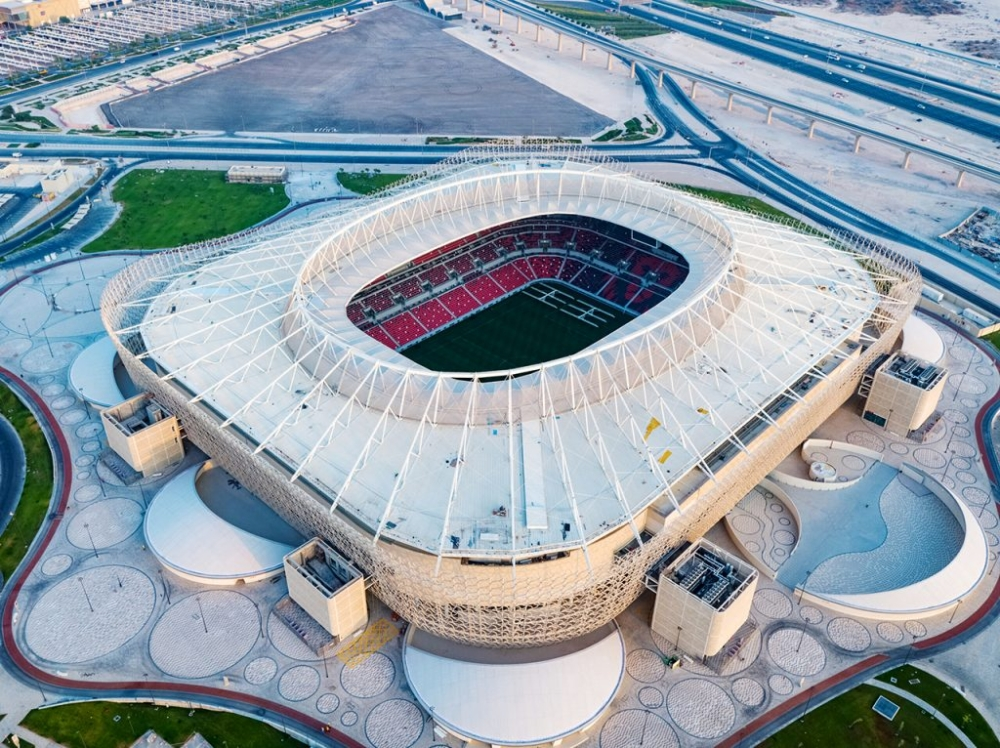
Located in Al Rayyan, its undulating exterior design reflects symbols of Qatari culture and the desert sand dunes. With a capacity of approximately 40,000, the stadium offers a vibrant, action-packed atmosphere, making it a favorite destination for passionate fans.
Stadium 974
Stadium 974 is a unique model of innovation and sustainability, having been built entirely using 974 shipping containers. It is the first fully demountable stadium in World Cup history. While its future after demolition is still being planned, hosting matches there during the Arab Cup will be a further celebration of its temporary and innovative legacy.
Education City Stadium
Known as the “Jewel of the Desert,” it is located in the heart of Qatar Foundation’s Education City. Its intricate architectural facade shimmers in the sunlight, its colors shifting throughout the day. With a capacity of approximately 40,000 spectators, the stadium embodies a harmonious blend of modernity and traditional Islamic architecture.