Reviving a heritage icon at the Al-Ahsa Bisht Festival
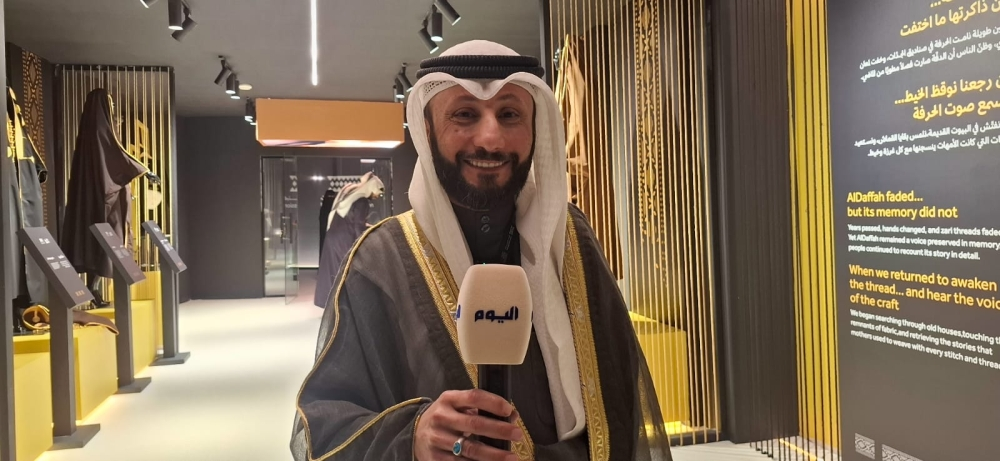
In the heart of the Al-Ahsa Oasis, as part of the "Al-Ahsa Bisht Festival" hosted by the Heritage Commission at the historic Ibrahim Palace, the "Beit Al-Daffa" pavilion stands as a testament to the rich heritage of traditional women's clothing in the region. The pavilion showcases the history of the "daffa," the traditional name for the Al-Ahsa women's abaya, highlighting four rare varieties that have transformed it from a mere folk garment into a cultural icon reflecting national identity and the authenticity of the past.
The festival, in its third edition, is witnessing a large turnout, especially from women who came to learn more about the details of weaving the “women’s duffah,” which is no less in quality and precision than the famous men’s bisht, which confirms the high status of this handicraft that has been passed down through generations.
Historical background of rudder making in Al-Ahsa
Al-Ahsa boasts a long history as a major center for fine textile production in the Arabian Peninsula. It has been renowned since ancient times for weaving men's bishts, worn by kings, princes, and dignitaries. With the same skill and precision, its artisans excelled in crafting women's duffahs. Researcher and Al-Ahsa bisht specialist, Mohammed Al-Amir, explains that the same artisans who mastered bisht weaving also crafted the details of the duffah, giving it a quality and value comparable to its men's counterpart. Al-Ahsa did not limit itself to local demand but also exported these luxurious cloaks to neighboring countries and various regions of the Kingdom.
Rare types of rudders and their social classification
The prince revealed the social and class classification reflected in the different types of rudders, which included four main types:
- The cloak: made from thick local wool, it was intended for Bedouin women and those with limited income. It was distinguished by its excessive length to ensure its durability and inheritance from mother to daughter.
- The wing: The attire of affluent families, intended for daily use, is woven from silk in the summer and soft wool in the winter, and decorated with zari and reed threads to reflect economic prosperity.
- The Suwai’iyah: A special occasion cloak worn by the families of the bride and groom. Its name is derived from its being worn only for specific hours, and it is distinguished by its delicate decorations.
- The Mahoud: This was the fourth and most luxurious type of dress, representing the bride's wedding gown on her wedding night. This outfit gradually disappeared more than 60 years ago with the rise of the white wedding dress.
“Al-Mahoud”: An artistic masterpiece and a human treasure
The “Mahoud” is considered the crown jewel among types of duffa, as its value was once equivalent to the cost of four luxurious men’s bishts, due to the density of zari (gold) threads used in its embroidery. Its value was not limited to the material aspect; it also carried a profound human dimension, embodying the spirit of social solidarity in the old neighborhoods known as “Farij.” It was exchanged and lent among neighbors and the women of the neighborhood to wear at their celebrations, thus easing the financial burden and strengthening community bonds.
Contemporary efforts to revive heritage
With the growing emphasis on national identity within the framework of Saudi Vision 2030, efforts have intensified to revive these traditional crafts. Associations such as the Antiquities and Heritage Association in the Eastern Province have initiated specialized courses in the production of traditional clothing, which have witnessed significant participation. In this context, Afnan Al-Qahtani, Public Relations Manager of the Al-Mahoud Factory, affiliated with the Al-Ahsa Girls Association, explained that the factory represents one of Saudi Aramco's initiatives to support handicrafts. She affirmed that the factory has successfully drawn inspiration from the traditional women's bisht (cloak) and presented the Al-Mahoud in an innovative, lighter, and more refined form, appealing to the tastes of the current generation without compromising its authentic and rich heritage.