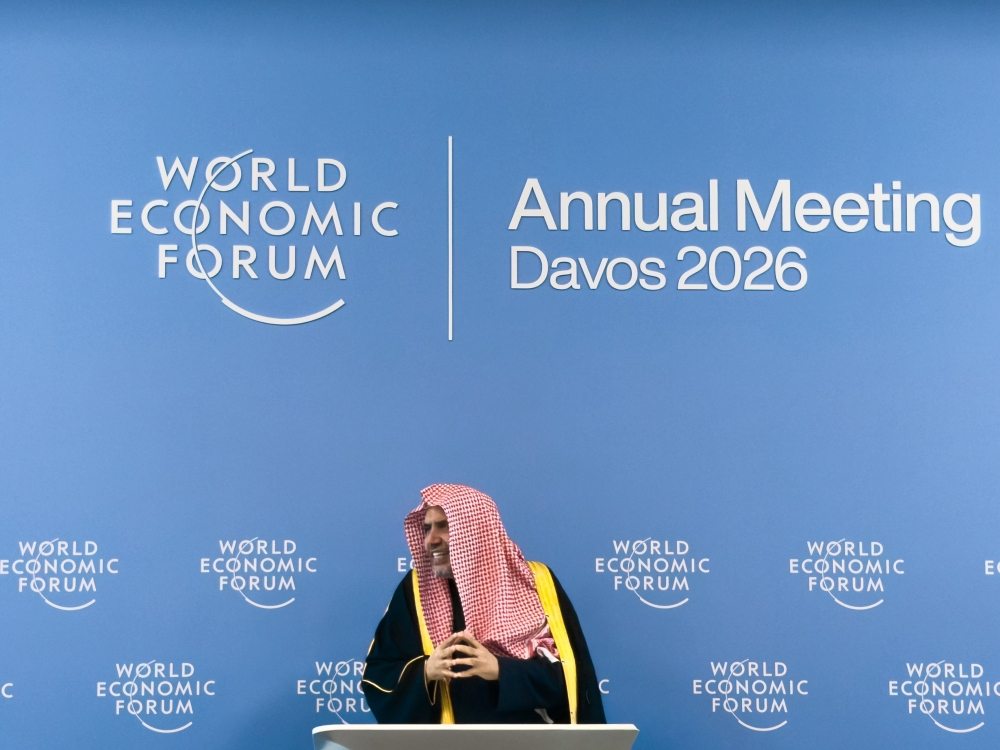
In a prominent international participation reflecting the growing role of religious diplomacy in addressing global crises, the World Economic Forum in Davos selected His Excellency the Secretary-General of the Muslim World League and Chairman of the Council of Muslim Scholars, Sheikh Dr. Mohammed bin Abdulkarim Al-Issa, to deliver the closing address for the religious and intellectual participation in its 2026 session. This selection confirms the strategic weight that the League represents as an international organization that seeks to promote the values of peace and tolerance.
Global initiatives to correct misconceptions
In his address, Dr. Al-Issa focused on highlighting a range of impactful initiatives spearheaded by the League, most notably the "Building Bridges of Understanding and Cooperation between East and West" initiative. This initiative, which received the support and endorsement of the United Nations at its headquarters in New York, was not merely a passing event, but rather a pivotal shift in the mechanisms of international dialogue. Its significance stems from being the first comprehensive international effort to include practical implementation programs aimed at dismantling theories of "the inevitability of a clash of civilizations"—theories that have long been exploited to fuel hatred and justify cultural and religious conflicts worldwide.
The Makkah Document: An Islamic Constitution for Coexistence
In discussing intellectual frameworks, the Secretary-General highlighted the "Makkah Document," a landmark document unprecedented in contemporary Islamic history. Issued in 2019 near the Holy Kaaba, it was endorsed by over 1,200 muftis and scholars representing various Islamic schools of thought and sects before being adopted by the 57 member states of the Organization of Islamic Cooperation. Al-Issa emphasized that this document recognized early on that intercultural dialogue is the only way to overcome obstacles to coexistence, stressing that Muslims are an integral and active part of contemporary human civilization, striving for the good of all humanity.
Islamic vision and shared human values
Dr. Al-Issa explained that Islam, with its comprehensive vision, aligns in its essence with universal humanitarian principles and the Charter of the United Nations. Islam views humanity as dignified and responsible beings, and establishes justice and mercy as fundamental pillars of social stability, free from any racial or religious discrimination. He noted that the Muslim World League has not only engaged in dialogue with others but has also worked to strengthen its internal structure through the "Document on Building Bridges Between Islamic Schools of Thought," which aims to end sectarianism and promote Islamic brotherhood. Currently, thousands of imams worldwide are being trained on the contents of this document to cultivate an enlightened religious discourse that rejects extremism and clearly distinguishes between the tolerance inherent in religions and the crimes committed by some of their adherents.