Saudi Arabia's national team tops a balanced group in the 2026 AFC U-16 Championship
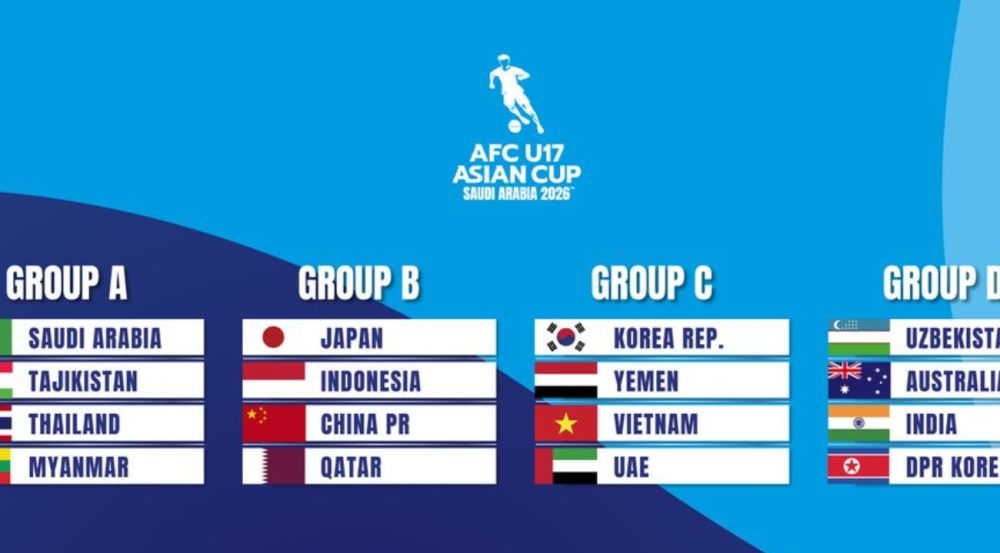
The draw for the 2026 AFC U-17 Championship, held on Thursday at the Asian Football Confederation headquarters in Kuala Lumpur, Malaysia, placed Saudi Arabia (the Green Falcons) in a relatively balanced group as the host nation. Asian football fans eagerly anticipate the start of this important tournament, which is significant not only for continental competition but also as the main gateway to qualifying for the 2026 FIFA U-17 World Cup in Qatar.
The Saudi Green Team's Path in Group A
The draw placed the Saudi Arabian youth national team, hosts of the tournament to be held from May 5 to 22, 2026, at the top of Group A, alongside Tajikistan, Thailand, and Myanmar. The "Little Green Falcons," who have won the title twice in their history (1985 and 1988), aim to capitalize on home advantage and secure a strong start, advance to the knockout stages, and ultimately reclaim the title they last won decades ago. This group presents an opportunity for the Saudi team to reaffirm their dominance in youth football, especially given the significant support the sport receives in the Kingdom.
Historical background and importance of the tournament
The AFC U-17 Championship, first held in 1985, is the premier platform for discovering young footballing talent in Asia. Throughout its history, the tournament has witnessed the emergence of stars who later became pillars of their national teams and clubs. The 2026 edition holds exceptional significance, as the top eight teams will qualify directly for the 2026 FIFA U-17 World Cup in Qatar, following FIFA's decision to expand the tournament to include more teams, thus raising the level of competition and making every match crucial.
Fierce clashes in other groups
The remaining groups were not without strong and exciting matches that promised fierce competition from day one, as 16 teams were distributed into four groups:
- Group A: Saudi Arabia (host), Tajikistan, Thailand, Myanmar.
- Group Two: Described as the “Group of Champions,” it brought together Japan (record holder with four titles), China (winner of two editions), Qatar (winner in 1990), and the ambitious Indonesian team.
- Group Three: This group will witness a strong struggle with the presence of South Korea (two-time champions), who will face strong Arab teams, namely the UAE and Yemen, in addition to the constantly developing Vietnamese team.
- Group Four: This is the “Group of Death” par excellence, as it includes Uzbekistan, Australia, North Korea (two-time champions), and India, which promises matches that cannot be drawn in two.
Qualification system and the road to the World Cup
The top two teams from each group qualify for the quarterfinals. From this stage, the eight qualified teams secure their places in the World Cup, making the quarterfinal matches crucial and decisive for all teams aspiring to participate in the world's biggest youth tournament.